




• Products
  • Insights
  • Practice Management
  • Resources
  • About Us
HALF
of parents
piggy bank with arrow crashing it
financially support their adult children
 
 
$1,474
average monthly support1

Mark is 64 and starting to think seriously about retirement. His daughter, Kayla, is 29.

A couple of years ago, when Kayla lost her job, Mark stepped in to help with rent. It was meant to be temporary.

But even after she found work, the support didn’t stop. First rent, then her cell phone, then car insurance. Each time something came up, Mark filled the gap.

Now, it’s simply what he does. They’ve never talked about when—or if—it ends.

Lately, Mark has been thinking about pulling back. But every time he does, the same worries start to creep in:

What if she can’t make it on her own?

What if she falls behind or goes into debt?

What if she loses her apartment?

What if this damages our relationship?

So, he keeps helping. And tells himself he’ll deal with it later.

At the same time, he’s beginning to notice something else: the continued support is taking a toll on his retirement savings—and it’s getting harder to ignore.

In my practice, I see this pattern often. Temporary support can quietly become an open-ended commitment—one that may be emotionally difficult to unwind.

Fortunately, there’s a way to better understand what’s driving this dynamic—and how to begin shifting it.


First, How Good Intentions Can Put Your Retirement at Risk

Let’s start with an important distinction: not all financial support is harmful.

Many parents provide thoughtful, intentional help—and it can be part of a healthy financial plan.

For example:

  • Helping fund a degree or vocational training with a clear endpoint
  • Providing support during a job loss or life transition, with a plan to phase it out
  • Contributing in a way that’s mutually understood and doesn’t disrupt long-term goals

This kind of support is purposeful, time-bound, and aligned with a broader plan.

But there’s another pattern I see more often.

It starts in a similar place—but gradually becomes ongoing, open-ended, and harder to step back from.

I call this over-responsibility—the belief that you are responsible for everyone’s happiness and safety.

When that belief is in play, financial decisions can shift. What looks like generosity on the surface is often driven by a deeper sense that you have to help.

This can show up as:

  • Covering ongoing living expenses without revisiting the plan
  • Stepping in quickly at the first sign of struggle
  • Continuing support even as it begins to affect your own financial future

The question isn’t whether helping is right or wrong.

It’s this:

  • Is this support part of a plan?
  • Or has it become something you feel responsible for maintaining—no matter the cost?
 

HALF
of parents
piggy bank with arrow crashing it
financially support their adult children
 
 
$1,474
average monthly support1

Second, Why It Can Be So Hard to Stop Helping

We’re wired to protect the people we care about—especially our children.

Inside the brain, there’s a system designed to scan for threats and keep us safe. Part of that system includes the amygdala, which acts like an early-warning center—constantly looking for anything that could go wrong.

That instinct is helpful in many situations. But when it comes to supporting adult children, it can sometimes take over.

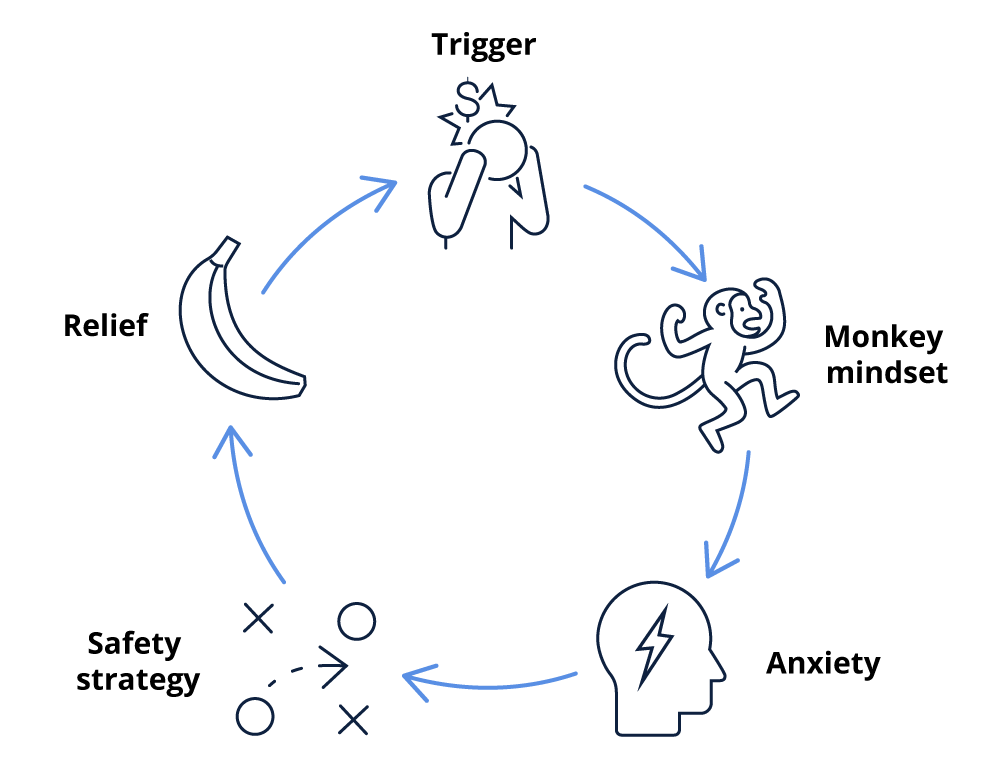
I call this pattern of thinking the “monkey mind.” Like a monkey, it tends to jump quickly from one negative thought to the next, fueling worry—especially in situations where someone we love might struggle. Its job is simple: anticipate problems and push us to act before anything bad happens.
 

Here’s how it often plays out:

  • Trigger: An adult child needs financial help

  • Monkey mindset: "If I don’t help, they could fall behind on rent or go into debt"

  • Anxiety: Stress chemicals can hijack rational thinking

  • Safety strategy: Stepping in to cover the expense

  • Relief: A sense that you’ve kept them from falling behind

Monkey Mind Diagram


In the moment, this response makes sense. It reduces worry and creates immediate relief.

But over time, it can quietly shift financial decisions in a different direction—away from long-term priorities and toward short-term reassurance.

That tradeoff can begin to put real pressure on retirement security—not because of one decision, but because the pattern keeps repeating.


Third, How to Start Shifting the Pattern

Recognizing the pattern is the first step.

The next step is learning how to respond differently.

I use a simple framework called the Expansion Exercise to help make that shift more concrete.

At its core, this approach helps you replace automatic reactions with more intentional ones.

A key part of that shift is the expansion mindset.

An expansion mindset is a more flexible way of seeing the situation—one that challenges the assumptions of the monkey mind. Where the monkey mind focuses on worst-case outcomes, the expansion mindset allows for other possibilities, including the idea that things may turn out better than expected, or that you and others are more capable than the fear suggests.

From there, the expansion strategy becomes much clearer: a small action that aligns with that mindset.

At a practical level, the Expansion Exercise breaks down into four parts:

  • Monkey mindset — the belief driving your reaction
  • Safety strategy — what you do to reduce discomfort
  • Expansion mindset — a more flexible way of seeing the situation, often challenging the monkey mind’s assumptions
  • Expansion strategy — one small action that aligns with that mindset

Another way to think about it: Expansion strategies are often the mirror opposite of the safety strategies we instinctively rely on.

Here’s how that can play out in a real situation:

Expansion Exercise Example: Supporting an adult child financially

Monkey Mindset: “If I don’t help them out, they won’t make it.”

Safety strategy: Keep stepping in financially

Expansion mindset: “They may be more capable than I realize.”

Expansion strategy: “I can limit the amount of financial help I give and, instead, support them with guidance and advice.”

Notice what’s changing here.

You’re not ignoring the situation or withdrawing support completely.

You’re shifting from an automatic reaction to a more intentional one—one that supports your long-term goals while still allowing you to help.

It’s also important to expect that this change won’t feel easy right away.

That discomfort isn’t a sign you’re doing something wrong—it’s a sign you’re doing something different. Over time, those small shifts can begin to change the pattern.

Starting the Conversation

Once you begin shifting your approach, a conversation is often the next step. A few simple ways to introduce it:

  • “I want to continue supporting you, but in a way that works long-term for both of us.”

  • “I’m going to start limiting financial support and focus more on helping you think through next steps.”

  • “Let’s set some expectations so we both know what this will look like going forward.”


If You Get Pushback

If the current pattern has been in place for a while, some resistance is normal. These responses can help you stay grounded without escalating things:

  • “I understand this is a change, and it may take some time to adjust.”

  • “This isn’t about not helping—it’s about helping in a different way.”

  • “I believe you’re capable of handling more of this than I’ve been allowing.”

60%

piggy bank with arrow crashing it
of parents say supporting adult children has
impacted their financial security1


“What If the Worst-Case Scenario Happens?”

This is often the biggest hurdle for parents.

When parents consider pulling back support, the mind quickly goes to the worst-case outcome.

What if they struggle financially?

What if they take on debt?

What if the relationship changes?

These concerns are real—and they deserve to be acknowledged.

When patterns shift, a few things may happen:

  • Your child may need to adjust their lifestyle or spending
  • They may make financial decisions you wouldn’t choose
  • They may express frustration—or pull back temporarily
  • They may test boundaries to see if the old pattern returns

These reactions can feel like confirmation that stepping back was the wrong decision.

But they’re also part of the adjustment process.

The question becomes:

  • Are you preventing short-term discomfort…
  • Or supporting long-term independence?


Conclusion

Helping your children is one of the most natural instincts there is.

The challenge isn’t whether to help—it’s how.

Left unchecked, even well-intentioned support can begin to put pressure on your retirement security. But with a more intentional approach, it’s possible to support your children while still protecting your future.


Next Step

If your current level of support is beginning to affect your long-term retirement plan, consider discussing it with your financial professional.

If the situation feels difficult to navigate, working with a financial therapist can also help you work through the emotional side of these decisions.

To take it a step further, try applying the Expansion Exercise to your own situation. Small shifts, applied consistently, can make a meaningful difference over time.


Author Headshot
Jennifer Shannon, LMFT, Cognitive Behavioral Therapist

Jennifer is a licensed psychotherapist and author specializing in anxiety treatment. She co-founded the Santa Rosa Center for Cognitive-Behavioral Therapy and has written several books, including “Don’t Feed the Monkey Mind.” Jennifer combines clinical expertise with practical tools to help people manage worry and live with greater confidence and ease.


The views and opinions expressed herein are those of the author, who is not affiliated with Hartford Funds.

1 50% of parents financially support adult children, report finds. Here’s how much it costs them, CNBC, 5/25/25

5527129