Pre-Sales Support
Mutual Funds and ETFs - 800-456-7526
Monday-Thursday: 8:00 a.m. – 6:00 p.m. ET
Friday: 8:00 a.m. – 5:00 p.m. ET
Post-Sales and Website Support
888-843-7824
Monday-Friday: 9:00 a.m. - 6:00 p.m. ET
An Enhanced Core Allocation
Alpha Capture ETFs are core allocations that aim to provide what passive strategies are not built to deliver: alpha potential.
Core Allocation Characteristics
| Cap-Weighted Index Funds | Alpha Capture ETFs | |
| Core Portfolio Fit |  | |
| Style Consistency | | |
| Intentional Risk Profile | | |
| Excess Return Potential | |
Complementary Sources of Alpha
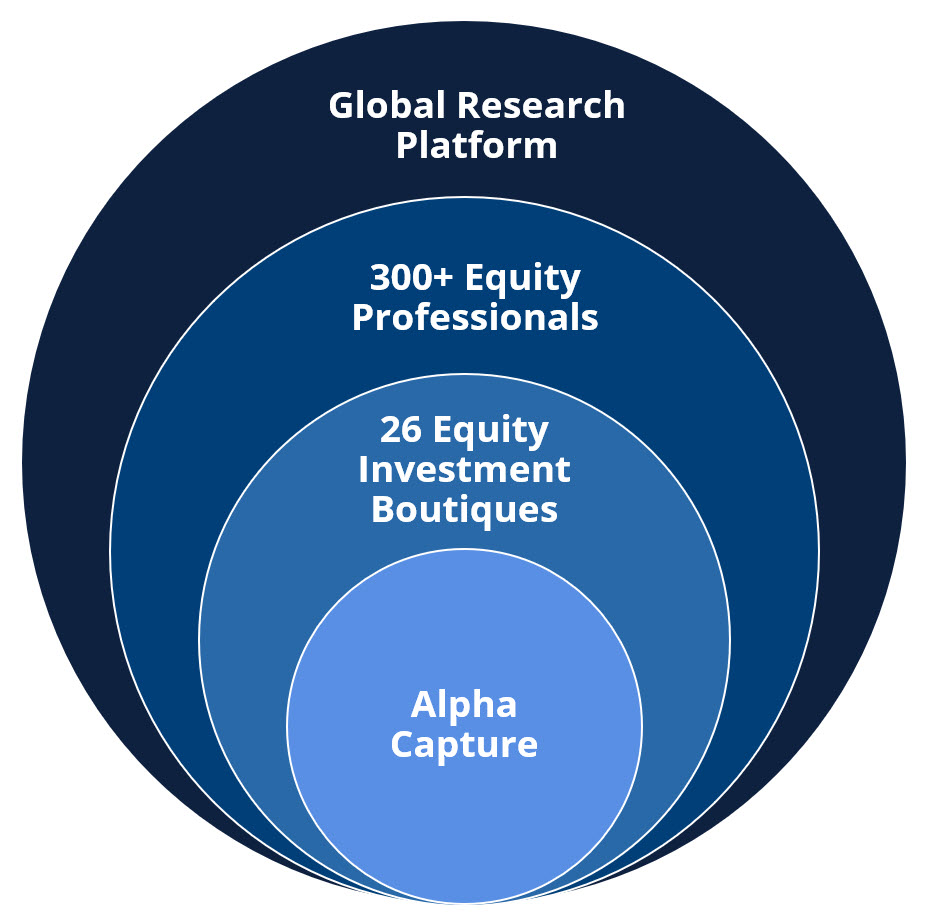
The suite draws on high-conviction ideas from multiple investment boutiques across Wellington's global equity platform―each contributing a unique approach to alpha generation.
Wellington’s Alpha Engine
Discipline by Design
Distinct investment perspectives are only as valuable as the framework that assembles them. Portfolio construction aims to balance style and sector exposures, focusing active risk on stock selection.
| Active Risk | Alpha Capture Approach | ||||||
| Stock Selection | Uses high-conviction stock selection as the primary driver of return potential | ||||||
| Manager Risk | Draws on multiple Wellington investors to diversify alpha and reduce manager risk | ||||||
| Sector Tilts | Limits unintended sector exposures to stay close to the benchmark | ||||||
| Factor Exposures | Seeks to manage factor exposures to limit unintended risk | ||||||
| Style Exposure | Maintains a consistent, style-pure profile |
Alpha Capture ETF Suite at a Glance
| Ticker | Hartford Funds ETFs | Benchmark | Morningstar Category | Total Operating Expenses (%) | ||||||||
| ACVU | Alpha Capture Value | Russell 1000 Value Index | Large Value | 0.45 | ||||||||
| ACGO | Alpha Capture Growth | Russell 1000 Growth Index | Large Growth | 0.42 (Net)/0.50 (Gross) | ||||||||
| ACIG | Alpha Capture Int’l Growth | MSCI EAFE Growth Index | Foreign Large Growth | 0.56 (Net)/0.65 (Gross) | ||||||||
| ACSM | Alpha Capture SMID Cap | Russell 2500 Index | Small Cap Blend | 0.52 (Net)/0.59 (Gross) | ||||||||
Total annual operating expenses for each Fund are from that Fund’s most recent prospectus at the time of publication. For ACGO, ACIG, and ACSM, gross expenses do not reflect contractual expense reimbursement arrangements. Net expenses for ACGO, ACIG, and ACSM reflect such arrangements in instances when they reduce gross expenses. These arrangements remain in effect until 2/29/28 unless each Fund’s Board of Trustees approves an earlier termination. Without these arrangements, performance for these would have been lower.
Go Deeper into the Alpha Capture Approach
Alpha Capture ETFs seek to unlock the power of high-conviction stock selection and transform it into a disciplined, style-pure core allocation designed for long-term investors.
The Wellington Edge
Founded in 1928, Wellington is one of the largest institutional asset managers in the world, with a deep global footprint and $1.4 trillion* in assets under management.
Global Resources
An extensive network of more than 800
investment professionals and research specialists fuel insight across all major
asset classes.
Private Partnership
Its unique partner-owned structure
fosters a culture of collaboration with tenured talent focused on long-term
client success.
Independent Thinking
Wellington’s ~50 independent yet
connected boutiques harness its scale and differentiated viewpoints to pursue
stronger outcomes.
*As of 6/30/26. Wellington Management refers to Wellington Management Company LLP and its affiliates. Firm assets include assets under management and non-discretionary assets.
Important Risks: Investing involves risk, including the possible loss of principal. Security prices of the Fund’s underlying holdings will fluctuate in value depending on general market and economic conditions and the prospects of individual companies. The market price of the Fund’s shares will fluctuate in response to changes in the Fund’s net asset value, intraday value of the Fund’s holdings, and the supply and demand for shares on the exchange. ● The Fund is actively managed and does not seek to replicate the performance of a specified index. ● The value of securities selected using quantitative analysis can perform differently from the market as a whole or from their expected performance. ● To the extent the Fund focuses on one or more sectors, the Fund may be subject to increased volatility and risk of loss if adverse developments occur. ● The Fund may have high portfolio turnover, which could increase its transaction costs and an investor’s tax liability.
ACGO: The Fund is new and has a limited operating history. ● The securities of large market capitalization companies may underperform other segments of the market. ● Growth investing style may go in and out of favor, which may cause the Fund to underperform other equity funds that use different investment styles. ● Because the Fund is non-diversified, it may invest in a smaller number of issuers, and may be more exposed to risks and volatility than a more broadly diversified fund.
ACIG: The Fund is new and has a limited operating history. ● Foreign investments may be more volatile and less liquid than U.S. investments and are subject to the risk of currency fluctuations and adverse political, economic and regulatory developments. These risks may be greater, and include additional risks, for investments in particular geographic regions or countries. ● Growth investing style may go in and out of favor, which may cause the Fund to underperform other equity funds that use different investment styles. ● Mid-cap securities can have greater risks and volatility than large-cap securities. ● The securities of large market capitalization companies may underperform other segments of the market. ● Because the Fund is non-diversified, it may invest in a smaller number of issuers, and may be more exposed to risks and volatility than a more broadly diversified fund.
ACSM: The Fund is new and has a limited operating history. ● Mid-cap securities can have greater risks and volatility than large-cap securities. ● Small cap securities can have greater risks, including liquidity risk, and volatility than large-cap securities. ● Because the Fund is non-diversified, it may invest in a smaller number of issuers, and may be more exposed to risks and volatility than a more broadly diversified fund.
ACVU: The securities of large market capitalization companies may underperform other segments of the market. ● Value investing style may go in and out of favor, which may cause the Fund to underperform other equity funds that use different investing styles. ● For dividend-paying stocks, dividends are not guaranteed and may decrease without notice.