• Products
  • Insights
  • Practice Management
  • Resources
  • About Us

In a feat not seen since 2019, global equities, bonds, and commodities all delivered positive returns in 2025,5 thanks to waning tariff concerns, central-bank easing, AI-driven growth, and the many splendors of gold. So, can the good times keep rolling in 2026, amid questions about valuations, an AI bubble, US-China relations, and other risks? We think four factors could drive positive results on balance but may cause choppiness along the way:

1. Earnings growth – The AI picture is complicated by increased competition and blowout spending. But we expect earnings strength to broaden beyond mega-cap tech and show up across regions, sectors, and market caps. Despite tariffs, companies have maintained and even expanded margins, giving us confidence that earnings improvements will translate to positive equity returns.

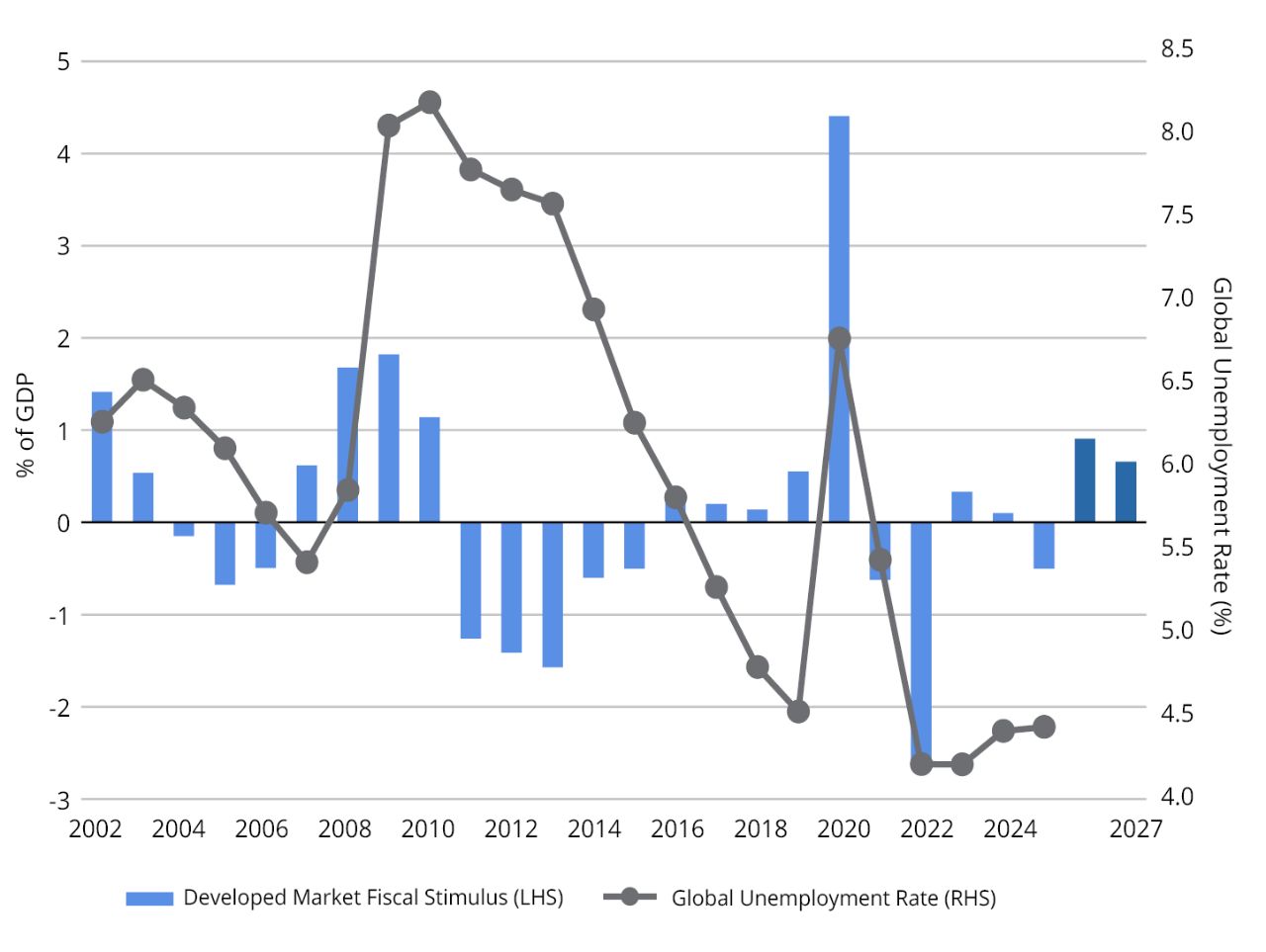
2. Global fiscal stimulus – Even if government debt is becoming a longer-term threat, every developed-market (DM) region has planned fiscal stimulus that should support nominal growth, consumer sentiment, and business investment (FIGURE 1).

3. Global interest rates – A cooling US labor market is driving Federal Reserve (Fed) easing expectations and supports our long duration6 stance. However, percolating inflation in the US and elsewhere could shift the landscape dramatically. Japan’s tighter monetary policy could be the first shoe to drop.

4. Political winds – Voters and markets could register their dissatisfaction with inflation and policy. Populist shifts in elections in the US, Europe, or Latin America could create volatility.

FIGURE 1

Global Fiscal Stimulus Is Coming
Fiscal Stimulus vs. Global Unemployment Rate

Chart Data: 2002-2027. DM fiscal stimulus calculated as the GDP-weighted change in cyclically adjusted balances across the US, European Union, UK, New Zealand, Canada, and Australia. Forward estimates (darker-blue bars) based on published fiscal plans from these same countries for the coming years. Data Sources: Wellington Management and National Finance Ministries.


These themes lead us to a constructive view on equities, though only slightly overweight relative to other asset classes. Within equities, we like Japan the most, given strong nominal GDP growth and positive earnings. We also like US equities and expect earnings breadth to improve thanks to fiscal stimulus and some cyclical acceleration in traditional industries. We’re less optimistic on the eurozone, the UK, and EMs, all of which enjoyed multiples expansion7 in 2025 but lackluster earnings growth.

In fixed income, steeper government yield curves, tight credit spreads, and concerns about AI-related debt supply leave us favoring government bonds over credit. A mismatch between bond prices, fundamentals, and policy underpins our preference for the UK over the eurozone and Japan.

Within commodities, we remain underweight oil, with supply expected to exceed demand, and hold a neutral view on gold as we wait for opportunities to add exposure at more favorable price levels.


Margin strength is one of the biggest surprises driving earnings.


Equities: Staying Constructive but with a Note of Caution

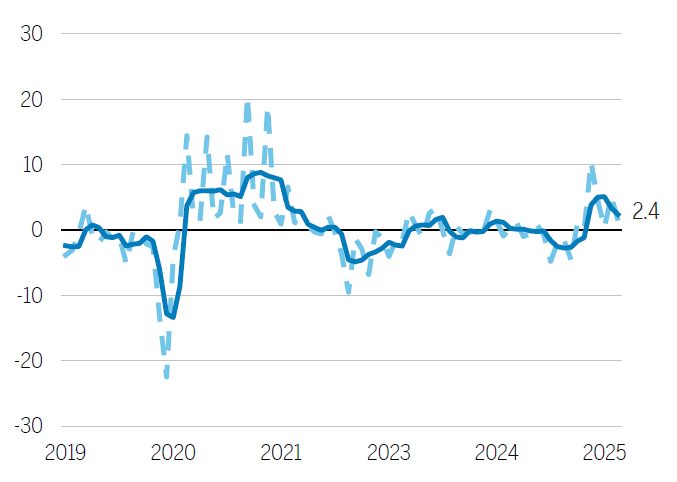
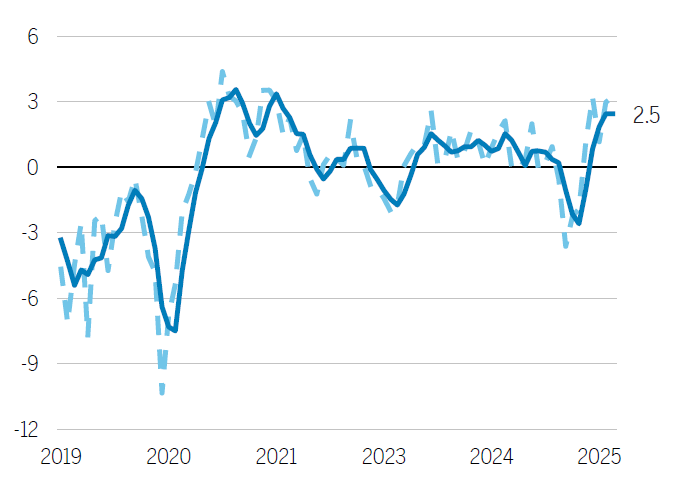
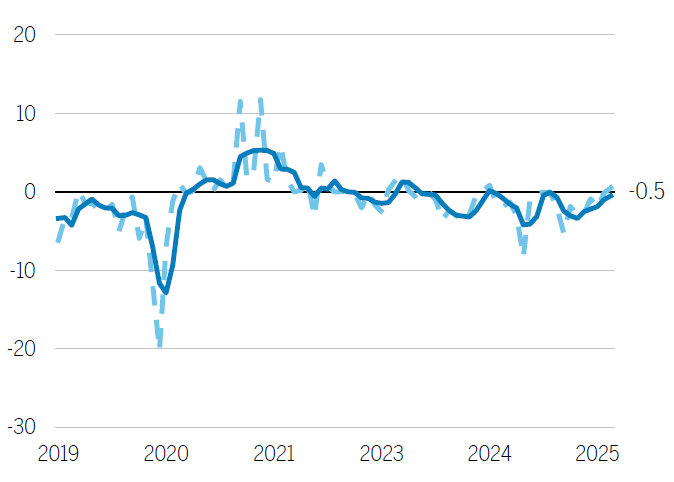
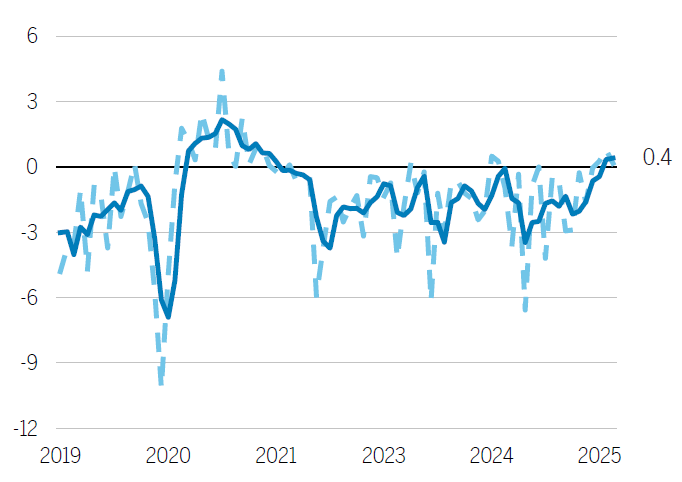
We maintain our moderately overweight view on global equities, given the positive monetary and fiscal policy backdrop and well-supported runway for earnings growth (FIGURE 2). After a year in which most markets (other than the US) generated more return through valuation expansion than earnings growth, we expect all major regions to post earnings growth of 6%–11% over the next 12 months. One of the biggest and most surprising factors driving earnings growth is margin strength. Despite uncertainties such as tariffs, large-cap companies have been able to expand margins—a testament to both their agility and to efficiency gains from innovation, including AI.


FIGURE 2

Positive Earnings Revisions in Most Regions

US: Earnings Revisions

Japan: Earnings Revisions

Europe: Earnings Revisions

EM: Earnings Revisions

– – – 1 Month Average     3 Month Average

Chart Data: 1/19-11/25. Earnings revisions breadth measures the difference between upward earnings estimate revisions and downward earnings estimate revisions, divided by the total number of earnings estimates. Indices used: MSCI USA Index, MSCI Europe Index, MSCI Japan Index, and MSCI Emerging Markets Index. Please see below for index definitions. Data Sources: Wellington Management, Refinitiv, and IBES. 


The modest level of our overweight view on equities stems partly from caution related to tight equity-risk premiums,8 which reflect a skew toward optimistic economic scenarios. Given risks around AI, momentum-driven rallies, and valuations, we expect occasional bouts of volatility.

We think Japanese equities could outperform other regions over the next 12 months. Strong nominal growth is a tailwind and, notwithstanding potential Bank of Japan rate hikes, monetary conditions remain loose with deeply negative real yields. Fiscal stimulus is about to turn even more positive, helping domestic sectors.


We expect US equities to outperform, based not just on mega-caps and AI, but also a broadening earnings-per-share recovery.

Our Multi-Asset Views

Asset Class View Change
Global Equities Moderately OW
DM Government Bonds Moderately OW
Credit Spreads Neutral downarrow
Commodities Moderately UW
Cash Underweight uparrow
Within Asset Classes  
Global Equities  
US Moderately OW
Europe ex-UK Moderately UW
UK Moderately UW
Asian DMs Moderately OW
EMs Neutral
DM Government Bonds
US Government Neutral uparrow
Eurozone Government Moderately UW
UK Government Moderately OW
Japan Government Moderately UW
Credit Spreads
Global Investment-Grade Credit Neutral
Global High Yield Neutral
EM debt Neutral downarrow

OW = overweight, UW = underweight

Views have a 6- to 12-month horizon and are those of the authors and Wellington’s Investment Strategy Team. Views are as of December 2025, based on available information, and are subject to change without notice. Individual portfolio management teams may hold different views and may make different investment decisions for different clients. This is not to be construed as investment advice or a recommendation to buy or sell any specific security.

We also expect US equities to outperform, based not just on mega-caps and AI, but also a broadening earnings-per-share9 recovery. Even small caps are experiencing positive earnings revisions, ending a multiyear downgrade cycle. We’re watching for signs that AI growth is relying on too much leverage, but fundamentals are still strong for spending, including AI demand/supply, and we think high free-cash-flow margins represent a good buffer.

Turning to the largest index weights in EM, we’re constructive on Korea and Taiwan but think India and China are more challenged. The global backdrop (lower US rates, a weaker US dollar) is supportive, but our lack of conviction on China and India makes it hard to be more constructive on the asset class overall. The anti-involution campaign10 seeks to rebalance toward efficiency, and ultimately profitability, rather than production growth. This, however, will likely take time. In the meantime, the market has seen a sentiment- and liquidity-driven surge, with little support from earnings or a broader macro recovery.

We have a moderately underweight view on Europe ex-UK and the UK. The eurozone macro outlook is improving, but is being held back by the lack of clear progress on structural reform and by direct competition from China on key profit pools in industries such as autos and clean technology. Fiscal uncertainty in France and other countries as well as the potential for new elections further cloud the outlook. We expect high single-digit earnings growth here, though the region has consistently disappointed vs. consensus estimates. The UK is still the market with our lowest earnings expectations. It suffers from a lack of tech sector exposure and from policy uncertainty, which is impacting investment and spending.


Fixed Income: Favoring Government Bonds Over Credit

Comparing credit to government bonds, we prefer the carry11 in higher-quality government bonds: Term premia are attractive and steeper yield curves are providing return from “rolling down the curve.”

Divergence is the story in government-bond markets, where cycles are less linked to the US. In fact, US 10-year rates rallied around 40 basis points (bps)12 year-to-date in 2025, while other DM regions’ yields sold off 5 to 90 bps, a highly unusual break in direction and magnitude from the past 10 years.13 Another sign of the divergence is in central-bank policy expectations, with the market pricing in rate cuts by the Fed in 2026 and rate hikes by other DM central banks. These conditions are ripe for relative value opportunities, reflected in our overweight view on UK rates and underweight view on eurozone and Japanese rates.

Having been overweight credit in various sectors during 2025, we think the overall market’s return profile is more balanced now, and have moved to a neutral stance. The backdrop remains positive for risk assets, but spreads are extremely tight, leaving little upside potential beyond carry. While we think the tech sector as a whole has room for leverage, as noted in the equities section, we’re keeping a close eye on growing AI capital expenditures (capex)14 funding in the credit markets, with the risk that some tech companies will allow their balance sheets to deteriorate.


Commodities: What’s Ahead for Oil and Gold?

We have an underweight view on oil. While we think demand will be well supported, including by sustained stockpiling by China, we expect supply to exceed demand beginning in the first quarter and continuing throughout 2026 as OPEC+ pares back its supply cuts. Risks to our views include military action in Venezuela (short-term downside risk to supply) and a ceasefire in Ukraine resulting in sanctions being lifted on Russia (upside risk to supply).

We continue to hold a neutral view on gold. Financial demand drivers remain solid, including central-bank buying and digital-asset (stablecoin) demand. Speculative positioning (futures) is back to high levels while exchange-traded product flows have been supportive. Structural tailwinds remain as well, including fiscal deterioration and concerns about central-bank independence. However, valuations are extreme—they’re at their highest level since 1980 relative to financial wealth.


Our Multi-Asset Views

Asset Class View Change
Global Equities Moderately OW
DM Government Bonds Moderately OW
Credit Spreads Neutral downarrow
Commodities Moderately UW
Cash Underweight uparrow
Within Asset Classes  
Global Equities  
US Moderately OW
Europe ex-UK Moderately UW
UK Moderately UW
Asian DMs Moderately OW
EMs Neutral
DM Government Bonds
US Government Neutral uparrow
Eurozone Government Moderately UW
UK Government Moderately OW
Japan Government Moderately UW
Credit Spreads
Global Investment-Grade Credit Neutral
Global High Yield Neutral
EM debt Neutral downarrow

OW = overweight, UW = underweight

Views have a 6- to 12-month horizon and are those of the authors and Wellington’s Investment Strategy Team. Views are as of December 2025, based on available information, and are subject to change without notice. Individual portfolio management teams may hold different views and may make different investment decisions for different clients. This is not to be construed as investment advice or a recommendation to buy or sell any specific security.

Investment Implications

  • Equity outlook looks favorable – The earnings and policy setup for equities is positive. At lofty valuations, however, markets will face questions about AI, fiscal stimulus, and great power competition. We think volatility could create opportunities to add risk. We also think better earnings breadth will make a case for diversifying across regions, sectors, and market caps.
  • Consider global government bonds as a play on attractive carry and regional divergence – The combination of tight credit spreads and attractive yields in some parts of the government-bond market tilts us toward holding a slightly long-duration view while focusing on the attractive term premium in the UK.
  • Consider taking profits in credit – We think historically tight spreads, concerns about balance-sheet erosion, and AI capex-induced supply warrant reducing exposure to a neutral weight. Since most total return during 2025 was captured after spreads widened, waiting for more attractive levels to add exposure may be prudent. 

Talk to your financial professional about how to position your portfolio amid a changing economic landscape. 


1 Spreads are the difference in yields between two fixed-income securities with the same maturity but originating from different investment sectors.

2 The yield curve is a line that plots interest rates of bonds having equal credit quality but differing maturity dates; its slope is used to forecast the state of the economy and interest-rate changes.

3 The term premium is the amount by which the yield on a long-term bond is greater than the yield on shorter-term bonds. This premium reflects the amount investors expect to be compensated for lending for longer periods.

4 Stagflation is an economic cycle characterized by slow growth, inflation, and signs of labor market weakness.

5 As of 11/30/25. Equities are represented by the MSCI ACWI Total Return Index, which is a free float-adjusted market capitalization index that measures equity market performance across global developed and emerging markets (net of dividend withholding tax), returned 21.07%. Bonds are represented by the Bloomberg Global Aggregate Total Return Index, which provides a broad-based measure of global investment-grade fixed-rate debt markets, returned 16.15%. Commodities are represented by the Bloomberg Total Return Commodity Index, which measures the performance of a broad group of commodity futures such as energy, metals, and agriculture, returned 7.89%. Data Source: Refinitiv.

6 Duration is a measure of the sensitivity of an investment’s price to nominal interest-rate movement.

7 Multiples expansion occurs when equity valuations rise because investors assign higher price-to-earnings or similar valuation ratios to companies, rather than due to underlying earnings growth.

8 Risk assets refer to assets that have a significant degree of price volatility, such as equities, commodities, high-yield bonds, real estate, and currencies.

9 Earnings per share measures how much profit a company makes per share of common stock.

10 China’s anti-involution campaign seeks to reduce wasteful, zero-sum competition among companies by discouraging excessive price cutting and overexpansion, and instead promoting efficiency, innovation, and sustainable growth.

11 Carry is the return an investor earns from holding an asset, typically from interest or yield, after accounting for financing or holding costs.

12 A basis point is a unit that is equal to 1/100th of 1% and is used to denote the change in a financial instrument. The basis point is commonly used for calculating changes in interest rates, equity indexes and the yield of a fixed-income security.

13 Data Source: Yield changes are Bloomberg as of 12/17/25. Measurement reflects the change in 10-year government bond yields for the US, Germany, France, Italy, Japan, the UK, and Australia since 12/31/24.

14 Capital expenditures are the money a company spends to buy or upgrade long-term assets such as buildings or equipment.

MSCI Emerging Markets Index is a free float-adjusted market capitalization-weighted index that is designed to measure equity market performance in the global emerging markets. MSCI index performance is shown net of dividend withholding tax.

MSCI Europe Index is a free-float adjusted market-capitalization-weighted index designed to measure the equity market performance of the developed markets in Europe.

MSCI Japan Index is a free-float adjusted market-capitalization index designed to measure large- and mid-cap Japanese equity market performance.

MSCI USA Index is a free float-adjusted market capitalization index that is designed to measure the performance of the large and mid cap segments of the US market.

Important Risks: Investing involves risk, including the possible loss of principal. • Foreign investments may be more volatile and less liquid than U.S. investments and are subject to the risk of currency fluctuations and adverse political, economic and regulatory developments. These risks may be greater, and include additional risks, for investments in emerging markets or if focused in a particular geographic region or country. • Small- and mid-cap securities can have greater risks and volatility than large-cap securities. • Fixed income security risks include credit, liquidity, call, duration, and interest-rate risk. As interest rates rise, bond prices generally fall. • Investments in high-yield (“junk”) bonds involve greater risk of price volatility, illiquidity, and default than higher-rated debt securities. • Investments in the commodities market may increase liquidity risk, volatility and risk of loss if adverse developments occur. • Diversification does not ensure a profit or protect against a loss in a declining market.

The views expressed here are those of the authors and are based on available information and are subject to change without notice. This information should not be considered as investment advice or a recommendation to buy/sell any security. In addition, it does not take into account the specific investment objectives, tax and financial condition of any specific person. Portfolio positioning is at the discretion of the individual portfolio management teams; individual portfolio management teams and different fund sub-advisers may hold different views and may make different investment decisions for different clients or portfolios. This material and/or its contents are current as of the time of writing and may not be reproduced or distributed in whole or in part, for any purpose, without the express written consent of Wellington Management or Hartford Funds.

MFGS_121925 5075546

Insight from sub-adviser Wellington Management
Nanette Abuhoff Jacobson Headshot
Managing Director and Multi-Asset Strategist at Wellington Management Company and Global Investment Strategist for Hartford Funds

Nanette Abuhoff Jacobson consults with clients on strategic asset allocation issues and works with investment teams throughout Wellington to develop relevant investment solutions across asset classes.

Author Headshot
Managing Director and Multi-Asset Strategist – EMEA at Wellington Management

ADVISOR WEBCAST

2026 Outlook: Elections, Earnings, and Global Stimulus