Pre-Sales Support
Mutual Funds and ETFs - 800-456-7526
Monday-Thursday: 8:00 a.m. – 6:00 p.m. ET
Friday: 8:00 a.m. – 5:00 p.m. ET
Post-Sales and Website Support
888-843-7824
Monday-Friday: 9:00 a.m. - 6:00 p.m. ET
Connecting with ideal prospects you’ve never met sounds too good to be true. Yet on LinkedIn, it’s possible.
With the right approach, you can identify the right prospects, reach out in a way that feels natural, and start conversations that lead to real opportunities. This article shows you how.
First, Start With the Right Search
Everything begins with how you define your ideal prospect.
The clearer you are about who you’re trying to reach, the easier it becomes to find them.
Think in searchable terms:
LinkedIn allows you to combine these attributes to create highly targeted searches. Start broad, then refine. Combining titles with transition phrases often surfaces more relevant opportunities.
Search for Career-Transition Prospects
People going through transitions are often more open to new conversations.
Use phrases like:
Use quotation marks to search exact phrases.
Then refine with filters like:
Search for Business Owners
Business owners often have complex needs and may not be well served by generic advice.
Start with titles like:
To improve results:
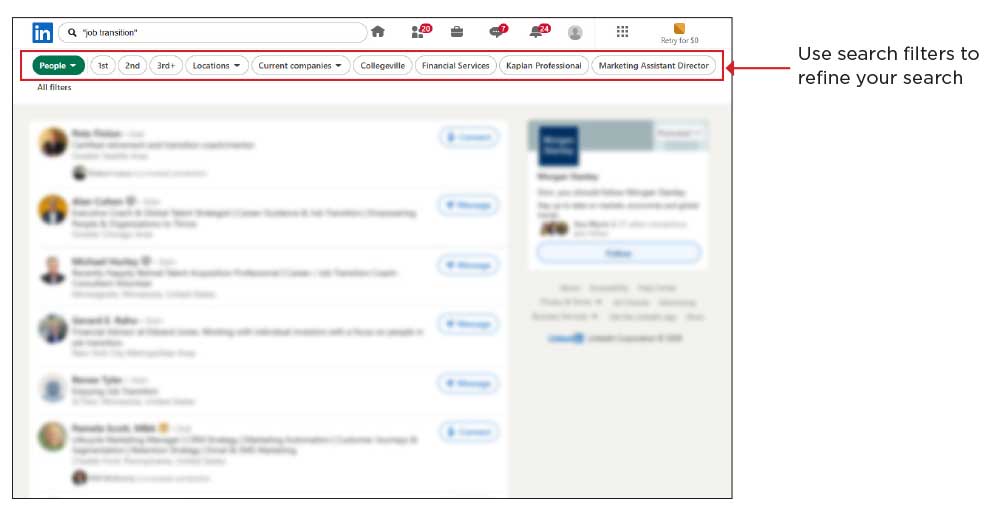
Search for Executives
Executives often face increasing financial complexity as compensation and responsibilities grow.
Use:
You can further refine by layering in signals:
This helps identify both who they are and what’s changing in their situation.
Search for COIs (Centers of Influence)
LinkedIn can also support relationship-building with potential referral partners.
Use:
From there:
Look for Signals—Not Just Titles
Titles help you identify the right people. Signals help you identify the right moment. Some of the most useful signals include:
When timing aligns with relevance, outreach is more likely to be well received.
Second, Reach Out: Keep It Personal and Relevant
Once you’ve identified a potential prospect, your objective is to start a conversation.
Strong outreach messages tend to follow a few consistent principles.
Start with Something Specific
Reference something about them:
This shows your message is intentional.
Example:
I came across your post on hiring challenges—especially your point about competition for talent. Curious how that’s playing out for you this year.
Give Context
Let them know why you’re reaching out.
Example:
I work with business owners who are navigating growth and transition, particularly around planning decisions that come up during expansion.
Without context, the message can feel random.
Keep It Conversational
Messages that feel natural tend to get more engagement.
Example:
Not sure if this is something you’re dealing with, but thought it was worth reaching out.
Make One Simple Ask
Keep your ask focused.
Example:
If it’s helpful, I can share a short piece we put together—just let me know.
Third, Follow Up Thoughtfully
Not everyone responds right away.
A short follow-up helps keep the door open.
Example:
Just wanted to circle back in case this got buried—happy to send that along if it would be useful.
Consistency matters. Tone should remain respectful and low-pressure.
A Simple Message Flow
Here’s how those elements can come together.
Message 1
Comment or question tied to something specific
Message 2
Add context and offer something of value
Message 3
Short follow-up and optional invitation to connect
This approach builds naturally:
Why This Approach Works
When outreach falls flat, it’s usually because:
When it works, it typically comes down to:
This approach is used well beyond financial services. In B2B sales, recruiting, and business development, professionals use LinkedIn in the same way—identifying specific people, reaching out with context, and starting conversations that lead to relationships.
Putting It Into Practice
To begin:
Over time, this becomes a repeatable process.
Final Thought
Many financial professionals rely on opportunities to come to them.
LinkedIn provides a way to create them.
With focused searches, thoughtful timing, and relevant outreach, simple conversations can turn into meaningful relationships—and over time, new client opportunities.
Next Step
Run your first targeted search on LinkedIn this week.
Then, select a handful and send a short, personalized message using the approach described in this article.
The goal isn’t to get immediate results. It’s to begin building a repeatable process for finding the right people and starting conversations.
Prior to using LinkedIn or implementing any of the strategies referenced in this presentation, please consult with your firm’s legal and compliance teams, social media policy, and required participation in social media programs.