


• Products
  • Insights
  • Practice Management
  • Resources
  • About Us

If you’ve been working most of your life and have arrived at your sixth decade, congratulations: You’re entitled to collect what could potentially be thousands of dollars in annual Social Security benefits. And if you’re married, you may be eligible for something more: a spousal benefit that can potentially provide a meaningful boost for spouses whose own work history may have produced a smaller Social Security benefit. For couples seeking to maximize retirement income, spousal benefits may be worth a closer look.

But the ins and outs of spousal benefits are complicated and frequently misunderstood. That’s too bad, because a spousal benefit, for those that qualify, can potentially provide as much as half of a higher-earning spouse’s full-retirement-age (FRA) benefit. 


Your Mileage May Vary

The strategy that works best for you ultimately depends on a host of factors, including: age differences, career earnings, level of savings, health status, and the date of your FRA (FIGURE 1). 

We’ll take a close look at three hypothetical couples—Joe and Ruth, Ann and Mike, and Norm and Karen—each approaching the claiming decision from different vantage points. But first, let’s review some of the basic Social Security rules that can impact whether some combination of regular benefits and spousal benefits may be right for you to consider.
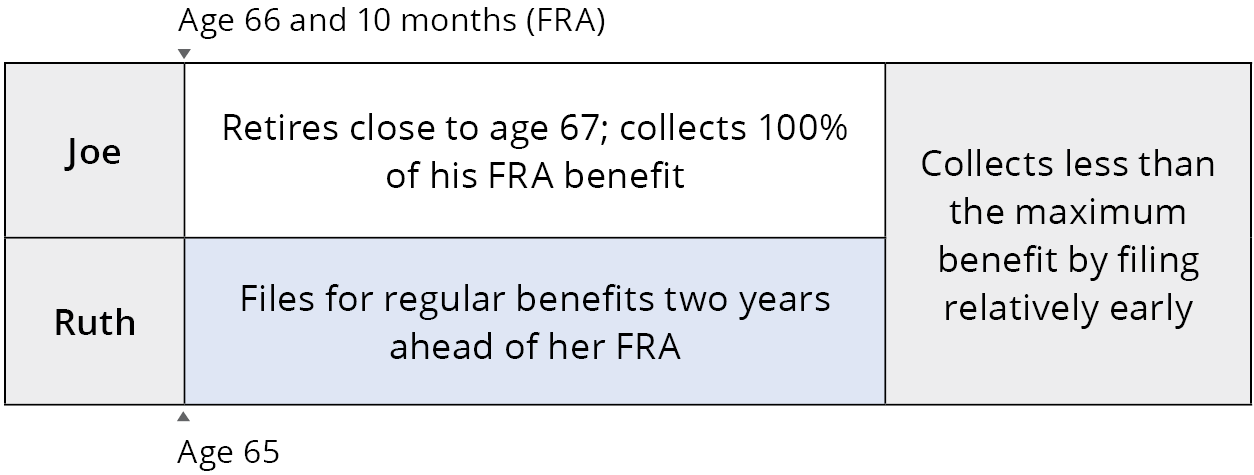
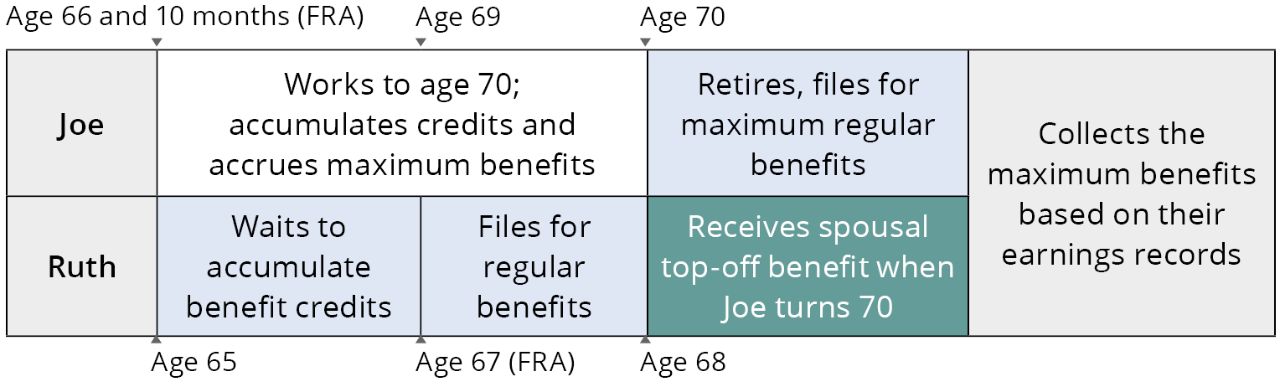
 

FIGURE 1

Social Security Full-Retirement Age (FRA)

If you were born in:   Your full-retirement age is:
1943-1954*   66
1955*   66 and 2 months
1956*   66 and 4 months
1957*   66 and 6 months
1958*   66 and 8 months
1959*   66 and 10 months
1960 and later   67

* Most individuals born between 1943 and 1959 have reached or will reach full retirement age by the end of 2026, depending on their month of birth. Source: SSA.gov


FIGURE 2

Spousal Benefits for Lower-Earning Spouses Are Reduced if Claimed Before FRA

Your Spouse's FRA Benefit Amount Your Age % of Your Spouse's FRA Benefit You Can Receive Your Benefit Amount
$2,000 62 32.50% $650
$2,000 63 35.00% $700
$2,000 64 37.50% $750
$2,000 65 41.70% $834
$2,000 66 45.80% $916
$2,000 67 50.00% $1,000

For illustrative purposes only. Actual benefits will vary. Assumes the lower-earning spouse’s full retirement age is 67. Percentages may differ for individuals with an earlier full retirement age. Source: SSA.gov


Spousal Benefits: What's Important to Know

Here's a short list of rules every potential spousal-benefit applicant should know.

  • Even if a marriage partner has earned little or no income in their prime years (e.g., full-time parents/homemakers), they can still claim spousal benefits.
  • A spouse can only claim spousal benefits when (or after) the higher-earning spouse claims their own benefits.
  • Spousal benefits can be claimed as early as age 62, but the benefit is reduced for early filing and reaches its maximum at your FRA. Claiming spousal benefits at 62 reduces the spousal benefit to only 32.5% of the higher-earning spouse’s full benefit amount (instead of 50% at FRA).
  • If you claim your regular Social Security benefit before your higher-earning spouse does, you may be eligible for what’s called an automatic “top off” to a spousal benefit at a later date when (or after) your spouse decides to file.* If you claim your own retirement benefit before FRA and later become eligible for a spousal top-off, your total benefit may be reduced because of the early claim.
  • You can’t collect a spousal benefit if your own regular retirement benefit is higher. If your potential spousal benefit is higher than your own retirement benefit, Social Security may pay your own benefit plus the spousal top off that brings your total up to the higher available amount.
  • Either spouse can maximize their regular Social Security benefit amount by waiting past their FRA to apply, up to age 70. Benefits generally increase 8% each year filing is delayed.
  • Spousal benefits don’t increase beyond the maximum 50% of the higher-earning spouse’s FRA benefits, so there’s no financial advantage for the lower-earning spouse to delay a spousal-benefit application past one’s own FRA.


* Under Social Security’s deemed-filing rules, SSA generally determines whether a person is eligible for a higher spousal amount when both retirement and spousal benefits are available. Because individual circumstances can vary, clients should confirm their eligibility and filing requirements with SSA.


To learn more details about spousal benefits and to see exactly what you’re entitled to collect at FRA, you should set up a mySocialSecurity account at SSA.gov. With all that in mind, let’s turn our attention to three hypothetical decision scenarios that a trio of married couples might face as they work together to maximize their joint Social Security benefits:


Scenario 1: Joe and Ruth (Claiming Early vs. Claiming Late)

Assumptions:

  • Joe, an engineering manager, has reached his FRA—66 and 10 months
  • Ruth, a schoolteacher most of her life, turns 65 this year and still works part-time as a substitute teacher
  • Joe and Ruth have a modest savings nest egg and are in good health

Option A: Claiming Early
Joe wants to claim his retirement benefits sooner rather than later, so, upon reaching his FRA, he chooses to apply for his $2,500-per-month entitlement. 

To bolster her modest $20,000 annual income as a substitute teacher, Ruth applies separately for her regular Social Security benefits—about $943 per month—even though, at age 65, she’s still two years away from her FRA.

Outcome: Joe and Ruth begin with a combined monthly benefit of $3,443, subject to future cost-of-living adjustments. Could they have improved on this strategy? Possibly, yes.

Joe and Ruth: Deciding Not to Wait Too Long for Benefits (Option A)

Joe and Ruth: Deciding Not to Wait Too Long for Benefits (Option A)


Option B: Claiming at Full-Retirement Age and Applying for a Spousal Benefit
Joe and Ruth each decide to maximize their benefits by waiting a few years.

For Ruth, waiting two more years to age 67—her FRA—enables her monthly benefit to climb from $943 to $1,100, based on her lifetime earnings history. Joe is now 69 and has one more year to reach 70 and claim his maximum benefit.

For Joe, waiting until his 70th birthday allows him to file for a maximum monthly benefit of about $3,150 (instead of the $2,500 he collects under Option A).*

Finally, now that Joe and Ruth are both collecting their regular benefit, Ruth can look forward to receiving a $150 automatic “top-off” adjustment to include a spousal benefit. Although Joe now collects $3,150 per month, Ruth’s spousal benefit would amount to 50% of her spouse’s FRA amount: $1,250 ($2,500 ÷ 2). That’s still $150 a month more than she would collect based on her own regular $1,100-per-month benefit. Fortunately for Ruth, she began collecting her original Social Security benefits at her FRA, so her top off won’t be subject to any early-filing penalties. Spousal benefits are capped at 50% of the higher-earning spouse’s FRA, even if that spouse can collect a higher amount by waiting until age 70 to file.

Outcome: If Joe and Ruth choose Option B, they’ll collect a lifetime benefit of $4,400 a month vs. $3,443 under Option A. That’s an extra $11,484 per year to help them stretch the money they’ve already saved. What’s more, by waiting until age 70 to claim his benefit, Joe provides a larger survivor benefit for Ruth if he dies first. 

* Joe’s hypothetical age-70 amount reflects estimated cost-of-living  adjustments in the interim years.

Joe and Ruth: Claiming at Full Retirement Age (Option B)

Joe and Ruth: Claiming at Full Retirement Age (Option B)


Scenario 2: Mike and Ann (Spouse With Little Earned Income)

Assumptions:

  • Mike, a sales manager, turns 65 this year—two years before his FRA—and wants to retire early to enjoy his grandchildren
  • Ann, a homemaker who raised four children, turns 62 this year, has some health issues, and worries about having limited benefits
  • Mike and Ann only have a modest $60,000 nest egg

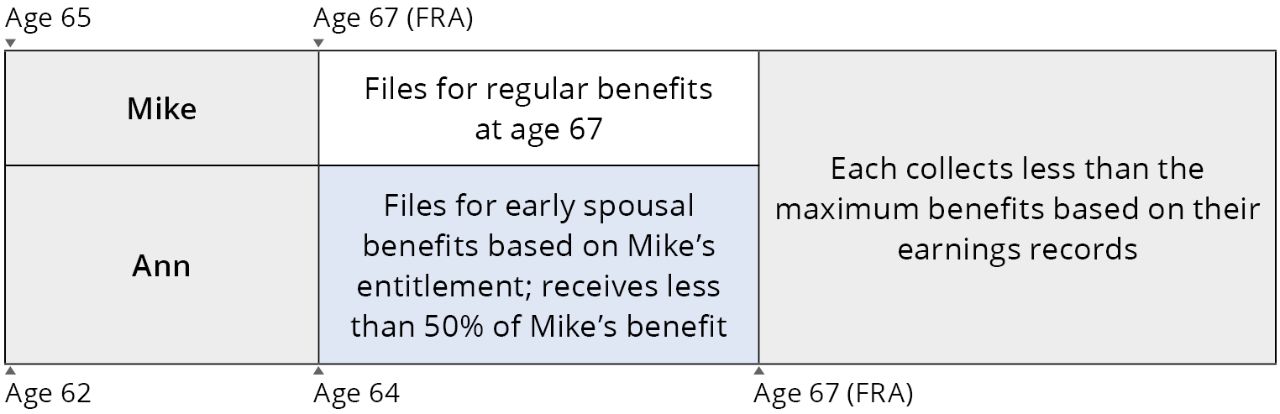
Option A: Early But Partial Spousal Benefits
Mike decides to keep working two more years until he reaches 67, his FRA, which enables him to claim 100% of his benefit entitlement: $2,800 a month.

Despite Ann’s health issues, she decides to wait two years (until age 64) when Mike begins to collect his own benefit. By waiting a bit, she can claim spousal benefits based on Mike’s earnings history. But since her own FRA is still three years away, she can collect only 37.5% of Mike’s benefit every month—or approximately $1,050.

Outcome: Claiming benefits at age 67 and 64, respectively, Mike and Ann will earn a joint monthly benefit of $3,850. 

Nevertheless, Ann considers herself fortunate to receive even a reduced spousal benefit since (a) her sparse work history would have left her with almost no Social Security benefits of her own, and (b) she needs the money up front to take care of health concerns.

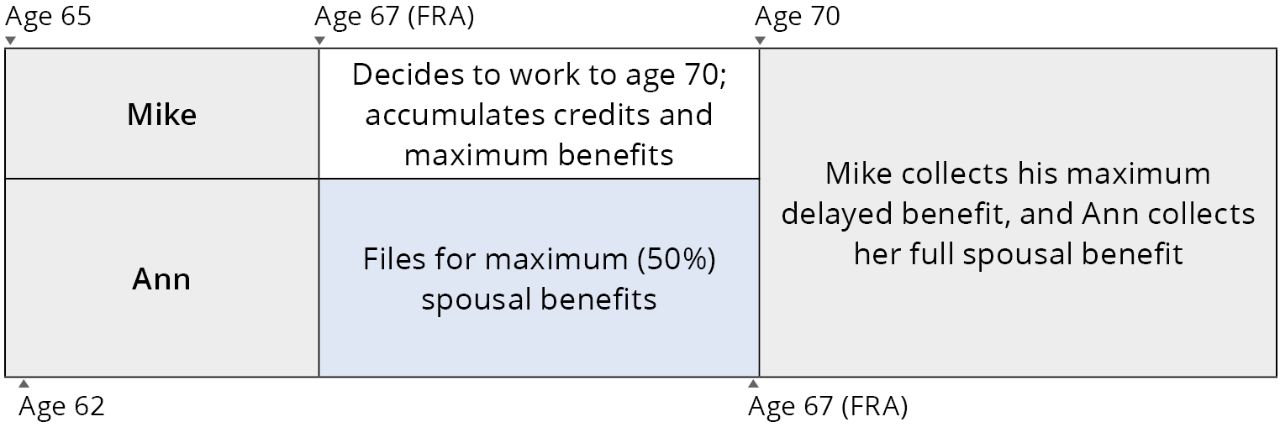
Option B: Taking a Chance on Waiting and Maximizing
Faced with health issues, Mike and Ann made a reasonable and necessary strategic decision with Option A, one that resulted in relatively smaller benefits. But what if their health and family circumstances changed, enabling each of them to wait a few more years? Waiting could open the door to a better maximum-benefit strategy.

Outcome: Mike holds out another five years until age 70 to collect his benefits. Instead of $2,800 a month, he now receives approximately $3,527 a month.* Ann waits five years until age 67,  her FRA, to collect her maximum 50% spousal benefit—$1,400 a month (half of her spouse’s FRA benefit of $2,800) instead of the $1,050 reduced spousal benefit under Option A. That’s a combined lifetime monthly income of $4,927 instead of the $3,850 they would receive under Option A.

* Mike’s hypothetical age-70 amount reflects estimated cost-of-living  adjustments in the interim years.

Mike and Ann: Claiming Early Spousal Benefits (Option A)

Mike and Ann: Claiming Early Spousal Benefits (Option A)


Mike and Ann: Combining Maximum Primary and Spousal Benefits (Option B)

Mike and Ann: Combining Maximum Primary and Spousal Benefits (Option B)


Scenario 3: Norm and Karen (FRA and a Spousal Benefit Top Off)

Assumptions:

  • Norm, a customer-service rep most of his working years, turns 66 and 10 months
  • Karen, a writer and editor who’s been the higher earner of the two, turns 65

Strategy: Maximizing Benefits with a Boost from the Automatic “Top Off”
Having hit his FRA, Norm is entitled to 100% of his own individual benefit—$1,200 a month.

Karen, who has earned a higher salary than Norm through the years, decides to postpone her claim so she can earn delayed retirement credits. Two years later, when she turns 67 (her FRA), she applies for her own individual benefit amount—$2,800 a month. At this juncture, their combined benefit adds up to $4,000 a month.

But now that Karen has claimed her individual benefit, Norm (now nearing 69) is entitled to an automatic $200-per-month spousal top off that raises his previous $1,200 monthly benefit to $1,400 a month—50% of Karen’s full-retirement-age benefit. Once Karen begins receiving benefits and SSA determines Norm is eligible for a higher spousal amount, his benefit is adjusted to include the applicable spousal supplement.

Outcome: Karen and Norm are now jointly earning $4,200 a month.


Talk to your financial professional to help you create a Social Security claiming strategy
that works for you and your spouse.


For illustrative and educational purposes only. The hypothetical situations described above are dramatized scenarios for pre-retirees and Social Security beneficiaries to consider, if they choose, during their own decision-making process and should not be construed as advice. The circumstances and strategies described herein may not reflect an actual client’s experience. The couples described in the above scenarios are fictitious and any resemblance between them and actual couples is coincidental.

All information provided is for informational and educational purposes only and is not intended to provide investment, tax, accounting, or legal advice. As with all matters of an investment, tax, or legal nature, you and your clients should consult with a qualified tax or legal professional regarding your or your client’s specific legal or tax situation, as applicable.

The preceding is not intended to be a recommendation or advice. This information does not take into account the specific investment objectives, tax and financial condition of any specific person. This information has been prepared from sources believed reliable but the accuracy and completeness of the information cannot be guaranteed. This material and /or its contents are current at the time of writing and are subject to change without notice.

CCWP133 5787024

The material on this site is for informational and educational purposes only. The material should not be considered tax or legal advice and is not to be relied on as a forecast. The material is also not a recommendation or advice regarding any particular security, strategy or product. Hartford Funds does not represent that any products or strategies discussed are appropriate for any particular investor so investors should seek their own professional advice before investing. Hartford Funds does not serve as a fiduciary. Content is current as of the publication date or date indicated, and may be superseded by subsequent market and economic conditions.

Investing involves risk, including the possible loss of principal. Investors should carefully consider a fund's investment objectives, risks, charges and expenses. This and other important information is contained in the mutual fund, or ETF summary prospectus and/or prospectus, which can be obtained from a financial professional and should be read carefully before investing.

Mutual funds are distributed by Hartford Funds Distributors, LLC (HFD), Member FINRA|SIPC. ETFs are distributed by ALPS Distributors, Inc. (ALPS). Advisory services may be provided by Hartford Funds Management Company, LLC (HFMC) or its wholly owned subsidiary, Lattice Strategies LLC (Lattice). Certain funds are sub-advised by Wellington Management Company LLP and/or Schroder Investment Management North America Inc (SIMNA). Schroder Investment Management North America Ltd. (SIMNA Ltd) serves as a secondary sub-adviser to certain funds. HFMC, Lattice, Wellington Management, SIMNA, and SIMNA Ltd. are all SEC registered investment advisers. The funds and other products referred to on this Site may be offered and sold only to persons in the United States and its territories.

Hartford Funds refers to HFD, Lattice, and HFMC, which are currently not affiliated with any sub-adviser or ALPS.

On June 3, 2026, The Hartford Insurance Group, Inc. (“The Hartford”) and Wellington announced that they had reached a definitive agreement under which Wellington Investment Advisors Holdings, LLP, Wellington’s corporate parent, will acquire Hartford Funds. Upon closing Hartford Funds will be integrated into Wellington’s U.S. Wealth business. The deal is expected to close in the first quarter of 2027, subject to regulatory and fund approvals. Upon closing, Hartford Funds would become an affiliate of Wellington. For more information, click here.

© Copyright 2026 Hartford Funds Management Group, Inc. All Rights Reserved. Not FDIC Insured | No Bank Guarantee | May Lose Value