Pre-Sales Support
Mutual Funds and ETFs - 800-456-7526
Monday-Thursday: 8:00 a.m. – 6:00 p.m. ET
Friday: 8:00 a.m. – 5:00 p.m. ET
Post-Sales and Website Support
888-843-7824
Monday-Friday: 9:00 a.m. - 6:00 p.m. ET
Annual Returns of Fixed-Income Sectors Represented by Indices
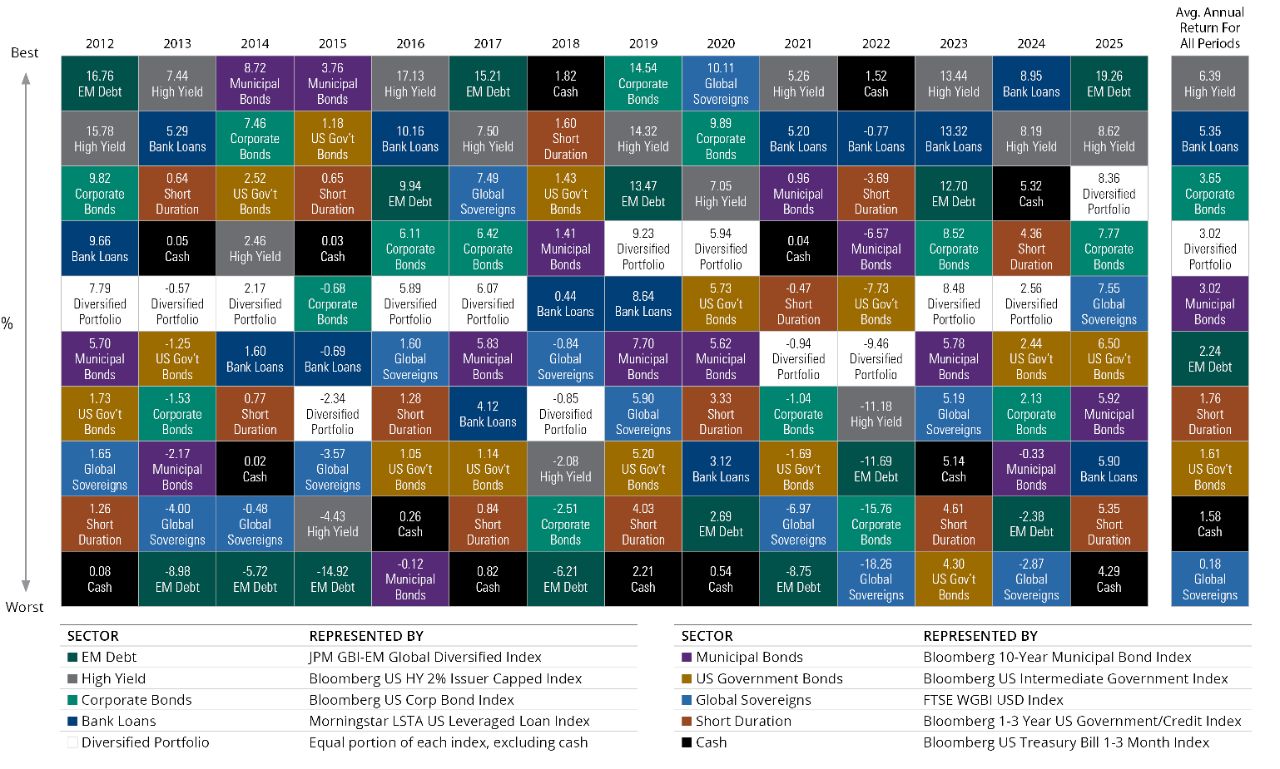
As of 12/31/25. Past performance does not guarantee future results. Indices are unmanaged and not available for direct investment, and do not represent the performance of any Hartford Funds product. See below for index definitions. Source: Morningstar, 6/26.
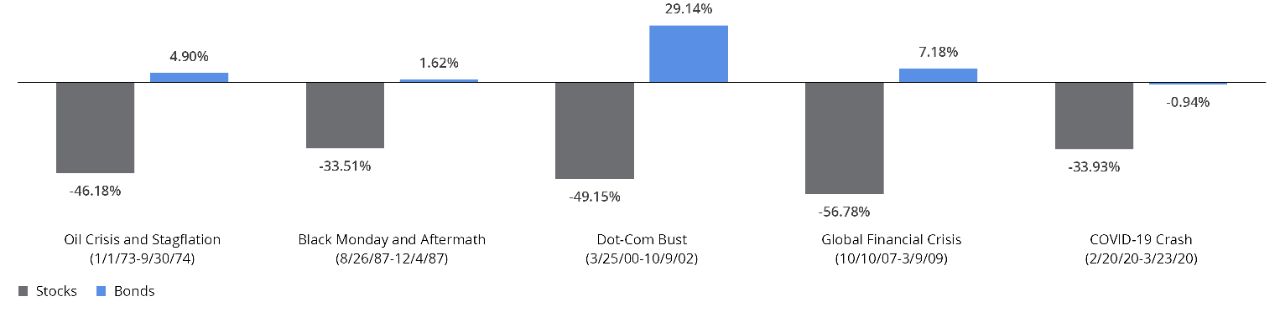
As of 12/31/25. Past performance does not guarantee future results. For illustrative purposes only. Time periods are based on data from Ned Davis Research. Stocks are represented by the S&P 500 Index—a market capitalization-weighted price index composed of 500 widely held common stocks. Bonds are represented by the IA SBBI LT Government Index, which measures the performance of a single outstanding U.S. Treasury note with a maturity term of approximately 5.5 years, until 1975, and thereafter by the Bloomberg U.S. Aggregate Bond Index, which is composed of securities covering the U.S. investment-grade fixed-rate bond market, with index components for government and corporate securities, mortgage pass-through securities, and asset-backed securities. Source: Morningstar, 2/26.
Bank Loans are represented the Morningstar LSTA US Leveraged Loan Index, which is a market-value-weighted index that is designed to measure the performance of the U.S. leveraged loan market based upon market weightings, spreads, and interest payments.
Cash is represented by the Bloomberg 1-3 Month US Treasury Bill Index tracks the market for treasury bills with 1 to 2.9999 months to maturity issued by the US government.
Corporate Bonds are represented by the Bloomberg US Corporate Bond Index, which measures the investment-grade, fixed-rate, taxable corporate bond market. The index includes US dollar-denominated securities that are publicly issued by industrial, utility, and financial issuers.
Diversified Portfolio is represented by an equal portion of the indices shown above, excluding cash.
EM Debt is represented by the JP Morgan GBI EM Global Diversified Index, which is a comprehensive global, local emerging-markets index, and consists of liquid, fixed-rate, domestic-currency government bonds.
Global Sovereign Bonds are represented by the FTSE World Government Bond Index (WGBI), which measures the performance of fixed-rate, local-currency, investment-grade sovereign bonds from over 20 countries.
High-Yield Bonds are represented by the Bloomberg US Corporate High Yield 2% Issuer Capped Index, which is a market-value-weighted benchmark for USD-denominated, non-investment-grade fixed-rate corporate bonds that restricts any single issuer from representing more than 2% of the Index.
Municipal Bonds are represented by the Bloomberg 10-Year Municipal Bond Index, which is the 10-year (8-12) component of the Bloomberg Municipal Bond Index.
Short-Duration Bonds are represented by the Bloomberg 1-3 Year Gov’t/Credit Bond Index, which is comprised of the US Gov’t/Credit component of the Bloomberg US Aggregate Bond Index.
US Government Bonds are represented by the Bloomberg US Intermediate Government Index, which is an unmanaged index reflecting performance of the intermediate-term government bond market.
Important Risks: Investing involves risk, including the possible loss of principal. • Fixed income security risks include credit, liquidity, call, duration, and interest-rate risk. As interest rates rise, bond prices generally fall. • Municipal securities may be adversely impacted by state/local, political, economic, or market conditions. Investors may be subject to the federal alternative minimum tax as well as state and local income taxes. Capital gains, if any, are taxable. • Investments in high-yield (“junk”) bonds involve greater risk of price volatility, illiquidity, and default than higher-rated debt securities. U.S. Treasury securities are backed by the full faith and credit of the U.S. government as to the timely payment of principal and interest. • Foreign investments may be more volatile and less liquid than U.S. investments and are subject to the risk of currency fluctuations and adverse political, economic and regulatory developments. These risks may be greater, and include additional risks, for investments in emerging markets.