Pre-Sales Support
Mutual Funds and ETFs - 800-456-7526
Monday-Thursday: 8:00 a.m. – 6:00 p.m. ET
Friday: 8:00 a.m. – 5:00 p.m. ET
Post-Sales and Website Support
888-843-7824
Monday-Friday: 9:00 a.m. - 6:00 p.m. ET
After US stocks spent the better part of 15 years outperforming, international stocks finally changed the tides in 2025. History shows that market leadership tends to ebb and flow, often in long stretches. The recent reversal suggests the cycle may be entering a new phase—one in which international markets could play a more prominent role.
US Equity vs. International Equity (1-Year Quarterly Rolling Returns)
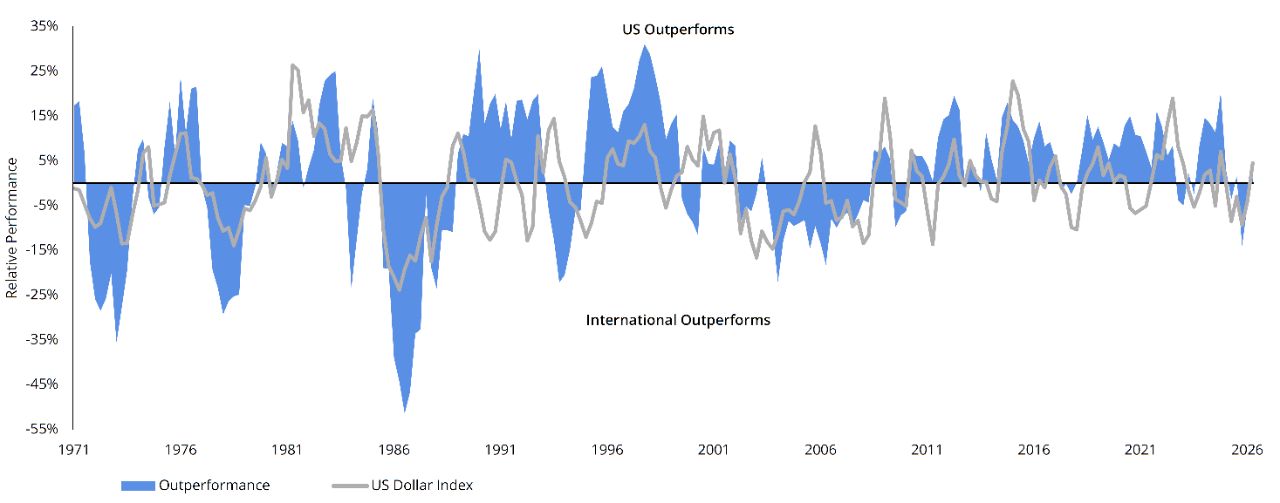
Chart Data: 3/31/71-6/30/26. Past performance does not guarantee future results. Indices are unmanaged and not available for direct investment. The performance shown above is index performance and is not representative of any Hartford Fund’s performance. The chart shows the values of the S&P 500 Index’s returns minus the MSCI World ex USA Index’s returns. When the line is above 0, domestic stocks outperformed international stocks. When the line is below 0, international stocks outperformed domestic stocks. US equity is represented by the S&P 500 Index; international equity is represented by the MSCI World ex USA Index. Please see below for representative index definitions. For illustrative purposes only. Data Sources: Morningstar, Bloomberg, and Hartford Funds, 7/26.
Talk to your financial professional today about the allocation to international equities that’s right for you.
Hartford Funds Global and International Equity Funds1
Morningstar Ratings for Mutual Fund I-Shares and Exchange Traded Funds (“ETFs”)*
1 View the full list of Hartford Funds
* ETFs are not mutual funds. Unlike traditional open-ended mutual funds, ETF shares are bought and sold in the secondary market through a stockbroker. ETFs trade on major stock exchanges and their prices will fluctuate throughout the day. Both ETFs and mutual funds are subject to risk and volatility.
MSCI World ex USA Index captures large and mid cap representation across developed market countries, excluding the US.
S&P 500 Index is a market capitalization-weighted price index composed of 500 widely held common stocks.
US Dollar Index measures the relative value of the US dollar against a basket of other foreign currencies.
Important Risks: Investing involves risk, including the possible loss of principal. • Foreign investments may be more volatile and less liquid than US investments and are subject to the risk of currency fluctuations and adverse political, economic and regulatory developments. These risks may be greater, and include additional risks, for investments in emerging markets.