Pre-Sales Support
Mutual Funds and ETFs - 800-456-7526
Monday-Thursday: 8:00 a.m. – 6:00 p.m. ET
Friday: 8:00 a.m. – 5:00 p.m. ET
Post-Sales and Website Support
888-843-7824
Monday-Friday: 9:00 a.m. - 6:00 p.m. ET
Hearing about vigilantes may have you imagining a Liam Neeson lookalike in an Armani suit with a particular set of skills. But some bond traders, more than willing to sell their Treasury holdings at the first whiff of inflationary excess, are known to administer their own brand of vigilante justice on financial markets now and then.
Market veteran Ed Yardeni coined the term “bond vigilantes” in the early 1980s to describe fixed-income investors who sell their holdings in response to fiscal conditions that threaten the economy. Their actions can push long-term Treasury yields higher, affecting everything from mortgage rates and corporate borrowing costs to the government's own borrowing costs.
While the Federal Reserve (Fed) exerts control over the short end of the yield curve,2 global bond investors, along with inflation expectations, fiscal deficits, and Treasury issuance, exert powerful influence over long-term Treasury yields. When investors become concerned about inflation, government borrowing, or other risks, they may sell bonds, pushing yields higher as they demand greater compensation for taking those risks. That's the basic idea behind bond vigilantes.
Recent moves in the Treasury market help illustrate the point (FIGURE 1). In 2021, the yield on the 30-year US Treasury hovered near 1.92%, offering fixed-income investors limited income. The 2022 rate shock pushed yields sharply higher as the Fed tightened policy.
Figure 1
Bond Vigilantes Are Pushing Up Long-Term Rates—Again
30-Year Treasury Yields Since 2021
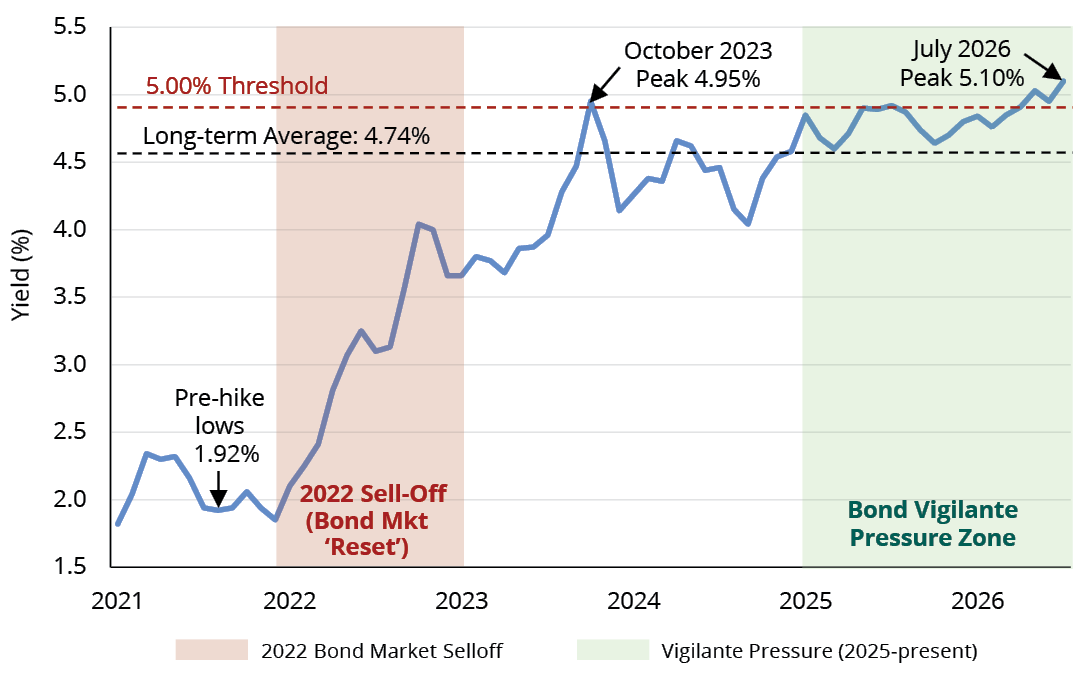
Chart Data: 1/1/21-7/1/26. For illustrative purposes only. Monthly average data through July 2026. Monthly data from 2021 to 2025 reflects approximate trajectory consistent with FRED annual averages. Sources: Federal Reserve Bank of St. Louis, Investing.com, and Hartford Funds, 8/26.
But the more telling move has come since 2025: Even after the Fed held rates steady, the 30-year yield moved back toward 5% and stood at a July monthly average of 5.10%—above its long-term average of 4.74%.3
When Treasury Buyers Get Spooked
That’s why the actions of global Treasury buyers matter. Large institutional investors, both domestically and from abroad, hold enormous amounts of US debt, including trillions in long-term securities. If those buyers become less comfortable with the inflation outlook or the fiscal trajectory, long-term rates may need to rise to attract sufficient demand.
Under new chair Kevin Warsh, the Fed now finds itself with little room for error. At Warsh's first meeting as chair in June, the Fed held short-term rates steady in a 3.50%–3.75% range. At the July meeting, policymakers again opted to leave rates unchanged, despite continued inflation concerns and dissents from several officials who favored a rate hike. The bond market's reaction was telling. Longer-term Treasury yields climbed sharply following the meeting as investors struggled to interpret the Fed's willingness to confront inflation decisively. The absence of a rate increase—or clear guidance on when one might occur—appeared to inject fresh concern about inflation and the Fed's commitment to fighting it.
Seeking a Balanced Approach
For fixed-income investors, the takeaway is balance—not avoidance. Today's higher yields may create attractive income opportunities, but the volatility that investors are enduring at the long end of the yield curve may not be appropriate for all portfolios. Short-to-intermediate duration bonds and carefully selected investment-grade credit may help clients capture income while limiting exposure to the most rate-sensitive parts of the curve.
To learn more about today’s opportunities in fixed income, talk to your financial professional.
1 Duration is a measure of the sensitivity of an investment’s price to nominal interest-rate movement.
2 The yield curve is a line that plots interest rates of bonds having equal credit quality but differing maturity dates; its slope is used to forecast the state of the economy and interest-rate changes.
3 The average of monthly 30-year Treasury constant-maturity yields over the trailing 30 years. Long-term average represents the arithmetic average of monthly observations for the 30 years ended 7/20/26. Source: Federal Reserve Board, H.15 Selected Interest Rates, 30-Year Treasury Constant Maturity Rate, via FRED.
Important Risks: Investing involves risk, including the possible loss of principal. • Fixed income security risks include credit, liquidity, call, duration, and interestrate risk. As interest rates rise, bond prices generally fall. • Investments in high-yield (“junk”) bonds are considered speculative, involve heightened credit risk and greater risk of price volatility, illiquidity, and default than investment grade bonds. • US Treasury securities are backed by the full faith and credit of the US government as to the timely payment of principal and interest. • Diversification does not ensure a profit or protect against a loss in declining market.
This information should not be considered investment advice or a recommendation to buy/sell any security. In addition, it does not take into account the specific investment objectives, tax and financial condition of any specific person. This information has been prepared from sources believed reliable, but the accuracy and completeness of the information cannot be guaranteed. This material and/or its contents are current at the time of writing and are subject to change without notice.