1 Dispersion measures how far apart asset returns or economic outcomes are from an average or a benchmark.
2 High yield refers to investments—most often bonds—that offer substantially higher interest rates than safer government or investment‐grade issues.
3 Securitized credit refers to tradable bonds or financial securities backed by a pooled collection of income-generating loans, mortgages, or other receivables rather than a single corporate entity. Common types of securitized credit include: mortgage-backed securities (backed by residential or commercial real estate loans) and asset-backed securities (backed by consumer or commercial debt such as auto loans, student loans, or credit-card receivables).
4 Capex (capital expenditure) is the money a company spends to buy, upgrade, or maintain long-term physical or intangible assets like buildings, equipment, or software.
5 Investment grade refers to a bond or debt security with a relatively low risk of default and a high credit quality.
6 The term “capital intensive” describes industries needing significant investment to produce goods or services. These industries leverage high fixed assets like property, plant, and equipment, resulting in increased depreciation costs.
7 A hyperscaler is a company that provides massive cloud computing and data storage infrastructure across huge, globally distributed data networks.
8 Leverage metrics are financial tools that measure how much debt a company uses to fund its operations and buy assets.9 A basis point is a unit that is equal to 1/100th of 1%, and is used to denote the change in a financial instrument. The basis point is commonly used for calculating changes in interest rates, equity indexes and the yield of a fixed-income security.
9 Hurdle rate refers to the minimum required return on an investment or project to be deemed acceptable, typically adjusted for risk.
10 A credit spread is the difference in yield between two debt securities with different credit quality but the same maturity..
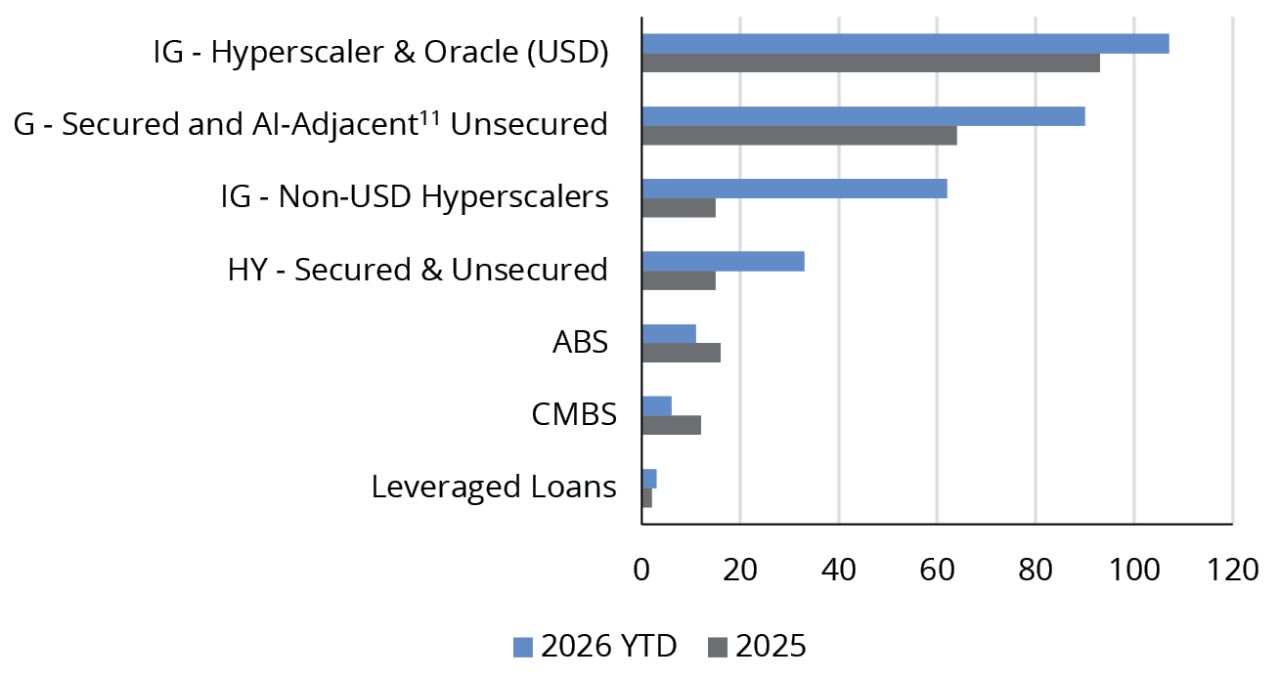
11 AI-adjacent refers to companies that support or benefit from the development and operation of AI infrastructure but are not primarily AI companies. These may include power, utility, telecommunications, equipment, and other infrastructure providers..
12 An asset-backed security (ABS) is a financial investment that derives its value and income from a pool of underlying assets, such as loans or receivables.
13 A commercial mortgage-backed security (CMBS) is an investment secured by commercial real estate loans, and which provides investors with regular income through interest payments.
14 A takeout can refer to either a long-term loan that replaces a short-term loan or, in a colloquial sense, the acquisition of a company through a merger or buyout.
15 Extension risk is the probability that borrowers remain in their loan longer than investors would like, because this defers the average payment cycle for secondary market product investors. In the primary market, lenders are mainly focused on contraction risk (also known as prepayment risk) which is the risk that a borrower will pay early and thus reduce the interest paid to a lender over the life of a loan.
Important Risks: Investing involves risk, including the possible loss of principal. Fixed income security risks include credit, liquidity, call, duration, event, inflation and interest-rate risk. As interest rates rise, bond prices generally fall. • Investments in high-yield (“junk”) bonds are considered speculative, involve heightened credit risk and greater risk of price volatility, illiquidity, and default than investment grade bonds. • Mortgage-related and asset-backed securities’ risks include credit, interest-rate, prepayment, and extension risk. • Focusing on one or more sectors, including the information technology, consumer discretionary and communication services sectors, may subject investors to increased volatility and risk of loss if adverse developments occur. • Private equity investments involve a high degree of business and financial risk that can result in substantial losses. • Loans can be difficult to value and less liquid than other types of debt instruments; they are also subject to nonpayment, collateral, bankruptcy, default, extension, prepayment and insolvency risks.
This information should not be considered investment advice or a recommendation to buy/sell any security. In addition, it does not take into account the specific investment objectives, tax and financial condition of any specific person. This information has been prepared from sources believed reliable, but the accuracy and completeness of the information cannot be guaranteed. This material and/or its contents are current at the time of writing and are subject to change without notice.
The views expressed here are those of the authors and are based on available information and are subject to change without notice. This information should not be considered as investment advice or a recommendation to buy/sell any security. In addition, it does not take into account the specific investment objectives, tax and financial condition of any specific person. Portfolio positioning is at the discretion of the individual portfolio management teams; individual portfolio management teams and different fund sub-advisers may hold different views and may make different investment decisions for different clients or portfolios. This material and/or its contents are current as of the time of writing and may not be reproduced or distributed in whole or in part, for any purpose, without the express written consent of Wellington Management or Hartford Funds.