





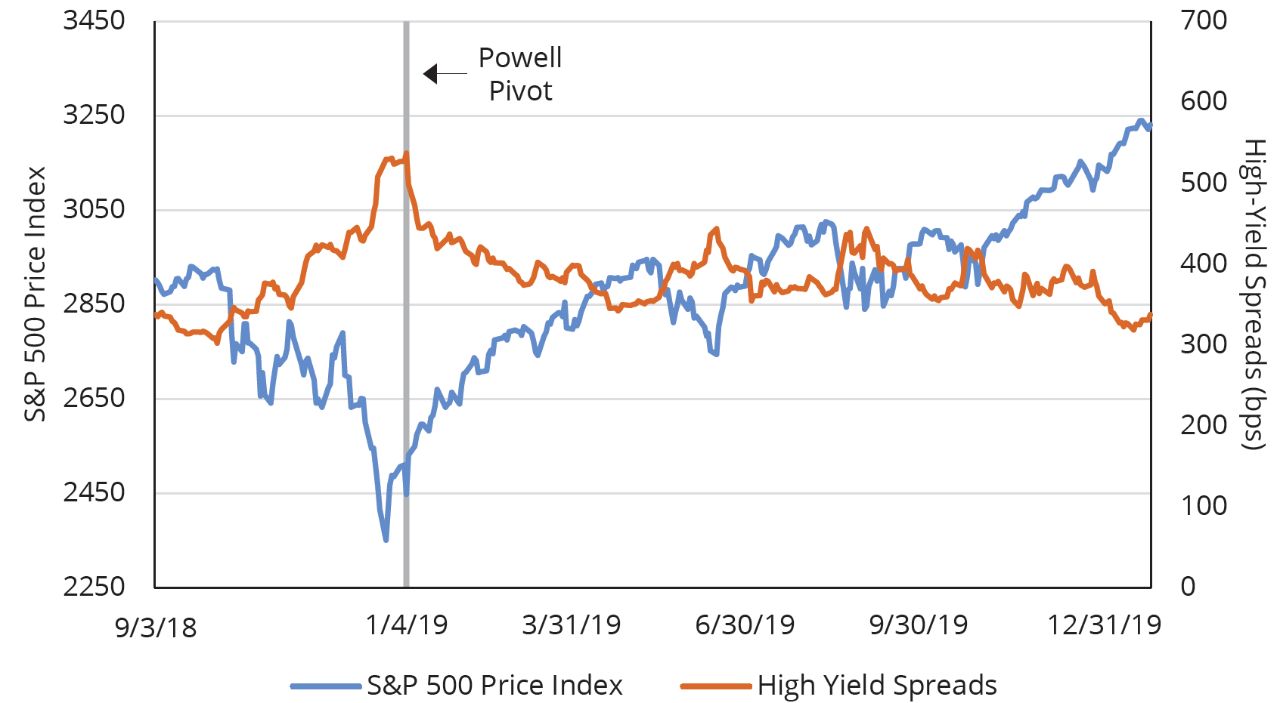
But while markets were calling for a pause, the Fed chair at the time, Jerome Powell, consistently communicated that the economy was strong, with low unemployment and little or no inflation. The Fed moved ahead with its planned hikes in September and December, but it wasn’t until January 2019 that Powell shifted his language, emphasizing that the Fed would be “patient” with future hikes.
The “Powell Pivot” saw equities rally 13.65% and high-yield spreads contract over 130 bps in the first quarter. It put a spotlight on how much influence Fed communications can have in moving markets. The Fed didn’t actually cut rates until July 31, 2019, but the impact was already felt.
Warsh hopes that by curtailing forward guidance, markets will rely on real-time market fundamentals instead of taking its cues from the Fed. In his words, he wants the market to “play the ball and not the referee.” In addition, he believes the lack of guidance gives the Fed more freedom to change course as the facts warrant without being locked into guidance it may have provided weeks before.
Warsh has formed a task force to review the Fed’s communications framework, including the future of the dot plot, how press conferences are conducted, and how FOMC statements are released. All in all, this represents a drastic shift from the past 15 years of Fed communications.
The Risks of a Less Transparent Fed
While every new leader has the right to reexamine how key functions are carried out across their organization, changes in Fed communications, or even uncertainty surrounding them, carry risks.
A less communicative Fed would not be unprecedented. During Alan Greenspan’s tenure as Fed chair from 1987–2006, policymakers revealed far less about their intentions in the early years, leaving investors to hunt for clues. Market watchers even scrutinized Greenspan’s briefcase: A bulging case supposedly signaled a rate hike, while a slimmer one suggested no change. The colorful but unreliable theory illustrated how little official guidance markets sometimes had. Transparency increased during Greenspan’s later years, but greater openness ensued under Ben Bernanke’s leadership as the Fed accelerated its use of communications to clarify its thinking and reduce uncertainty following the GFC.
But reversing that trend could make policy more difficult to anticipate, prompting investors to price in a wider range of outcomes and demand greater compensation for uncertainty. The result could be more interest-rate volatility and, potentially, structurally higher rates. Think about banks that fund themselves in multiple ways (deposits, bonds, equity) over various terms (short, medium, long). If even a portion of their fund pricing becomes harder to predict, the bank will need to account for potential higher costs, which can be passed on to borrowers for mortgages, auto loans, and other forms of credit.
Further, greater rate volatility generally makes hedging more expensive, more difficult, and less precise, which can have significant consequences across the financial system. This volatility drives up costs, not just for banks and mortgage lenders but also for insurance companies, pension funds, and fund managers. The potential exists for higher costs or lower margins across a number of industries.