



• Products
  • Insights
  • Practice Management
  • Resources
  • About Us

As Washington moves toward the summer months, policy decisions are unfolding against a backdrop of global disruption and domestic constraint. Legal challenges, geopolitical conflict, and narrow political margins are shaping not just what gets done, but how it gets done. Rather than driving sweeping change, the political environment is pushing policymakers toward narrower choices and incremental adjustments—dynamics that are now beginning to surface more clearly across both domestic and foreign policy.


Energy, Inflation, and the Cost of the Iran Conflict

The fallout from the Iran conflict is increasingly being felt through higher energy and gasoline prices, with knock‑on effects for inflation. Those pressures complicate the domestic economic backdrop at a moment when energy costs remain highly visible to consumers. The challenge, however, extends well beyond US borders. Disruptions tied to the conflict are reverberating through global energy markets and trade flows, creating second‑order effects that governments and industries are still working to absorb.

Oil is only part of the story. Key inputs such as diesel, liquefied petroleum gas, fertilizers, and helium (which is critical for semiconductor manufacturing) move through the Strait of Hormuz. In 2024, more than 80% of these supplies were destined for Asian markets.1 As a result, energy‑import‑dependent economies in Asia are experiencing the most immediate strain, while Europe remains vulnerable to higher electricity and transportation costs if elevated energy prices persist.

The longer‑term implications are likely to be uneven. China, for example, may prove relatively resilient given its strategic oil reserves and its ability to substitute toward coal in certain industrial uses. Elevated fossil-fuel prices could also accelerate investment and policy support for renewables, potentially reinforcing China’s existing momentum in clean-energy deployment.

Higher oil prices linked to the Iran conflict have also delivered an indirect boost to Russia’s fiscal position, complicating US and allied policy objectives. In an effort to stabilize global energy markets, the administration moved early to allow Russian crude flows to continue to India, a notable shift after earlier threats of tariffs tied to those purchases. That recalibration appears to have sidelined bipartisan Senate efforts to impose penalties on countries buying Russian energy exports, despite broad support for the legislation. The redistribution of attention and resources also carries implications for Ukraine, as air defense systems and other high‑demand military assets are being redirected toward the Middle East. In that sense, the conflict’s energy shock extends beyond prices, forcing difficult trade-offs across sanctions policy, alliance management, and security priorities.


Spending and Policy Ambitions

Republicans are weighing a second major legislative push through the budget reconciliation process following passage of the One Big Beautiful Bill Act in 2025. Using reconciliation would allow a new spending package to clear the Senate with a simple majority, aligning with efforts to sharpen the party’s economic message ahead of the midterms. Proposals under discussion range from additional tax cuts to roughly $200 billion in defense spending and new immigration‑related funding.

The effort faces meaningful hurdles. The timeline is compressed, House Republicans hold only a narrow majority, and consensus remains elusive—even within the party. President Donald Trump has pressed Speaker Mike Johnson (R-LA) to pursue reconciliation again, including during and after his State of the Union address, but legislative history suggests the path forward is narrow. Delivering a second, sweeping package would require near‑perfect party discipline and rapid agreement on scope—conditions that appear unlikely. For now, expectations should be tempered.
 

Housing Policy Remains Stuck Despite Bipartisan Concern

Housing affordability remains a rare area of bipartisan acknowledgment, but legislative momentum is lacking. The House and Senate have advanced distinct approaches that show little sign of converging. House Republicans have passed measures aimed at expanding supply through regulatory relief, zoning incentives, and greater use of federal land. Senate Democrats, meanwhile, have focused on narrower proposals centered on affordable-housing programs, tax credits, rental assistance, and first-time homebuyer support.

Despite shared recognition that high housing costs are a national concern, the chambers remain divided over scale, spending levels, and the appropriate federal role. As a result, most proposals remain stranded without a clear path to bicameral agreement. Lawmakers may ultimately settle for messaging victories rather than force difficult compromises, leaving housing policy in limbo despite its political significance. A negotiated package is still possible, but the window narrows as summer approaches and legislative priorities compete for floor time.


New Leadership at the DHS

The Department of Homeland Security (DHS) remains shut down, disrupting air travel and delaying a range of federal programs, but it has moved forward with new leadership. Former Senator Markwayne Mullin has been confirmed as DHS secretary, taking charge of immigration enforcement amid growing political and operational constraints.

Mullin’s appointment as DHS secretary signals a shift in execution, not direction.

Mullin isn’t expected to shift the administration’s hardline stance on deportations or asylum policy. Instead, the change is likely to be one of execution rather than direction. Compared with former DHS Secretary Kristi Noem, enforcement under Mullin is expected to be less media‑driven and confrontational, and more targeted, operational, and politically calibrated. Deportation totals may remain high, but tactics and optics are likely to evolve, with narrower targeting, greater internal coordination, and more attention to political and public backlash.

Republican lawmakers describe Mullin as pragmatic and politically aware, even as he strongly supports ICE and Customs and Border Protection. Early signals point to a move toward fewer high-profile raids and away from broad urban dragnet operations toward prioritizing migrants with criminal records and fewer high‑profile raids. The net effect could be a steadier enforcement pace and fewer workplace disruptions, potentially reducing the economic shock in sectors reliant on undocumented labor even if overall removals remain elevated.


Trade Policy in Flux

In February, the Supreme Court struck down Trump’s “Liberation Day” tariffs, putting nearly $170 billion in potential refunds at stake and forcing the administration to search for alternative authority. To preserve leverage, the White House turned to Section 122 of the Trade Expansion Act, imposing temporary tariffs of up to 15% for 150 days. While those measures could raise an estimated $35–50 billion, they’re already facing legal challenge.

An adverse ruling on tariffs could push the total financial impact of refunds above $200 billion.

The Court of International Trade is scheduled to hear arguments in early April, with challengers arguing that the tariffs fail to meet the statute’s requirement of a serious balance‑of‑payments deficit, even as courts have historically granted the executive branch wide latitude on trade. An adverse ruling could push the total financial impact of refunds above $200 billion. However, by the time appeals are exhausted, the Section 122 tariffs will likely have expired. The administration appears prepared to pivot toward Sections 301 and 232 instead, shifting the legal battleground from tariff authority to the size and timing of the Treasury’s refund obligations.
 

USMCA Under Review Ahead of July Deadline

The administration is also using trade uncertainty as leverage closer to home. Trump has privately raised the possibility of withdrawing the US from the US‑Mexico‑Canada Agreement (USMCA) ahead of the mandatory six‑year review on July 1, framing the threat as a way to extract additional concessions from Canada and Mexico. Demands under discussion range from stricter rules of origin for industrial goods to issues well outside traditional trade negotiations, including migration and drug enforcement.

Although officials emphasize that withdrawal isn’t a settled decision, even the suggestion has introduced volatility into the $2 trillion North American trading relationship, contributing to fluctuations in the Canadian dollar and Mexican peso. Consultations and public hearings concluded late last year, and the US Trade Representative has been laying groundwork with Congress and stakeholders to signal that renewal won’t be automatic. For now, USMCA remains in force, talks are active, and uncertainty appears intentional—keeping both partners engaged while the White House assesses whether additional leverage can produce a “better deal” ahead of the July decision.


House Retirements Signal Midterm Headwinds

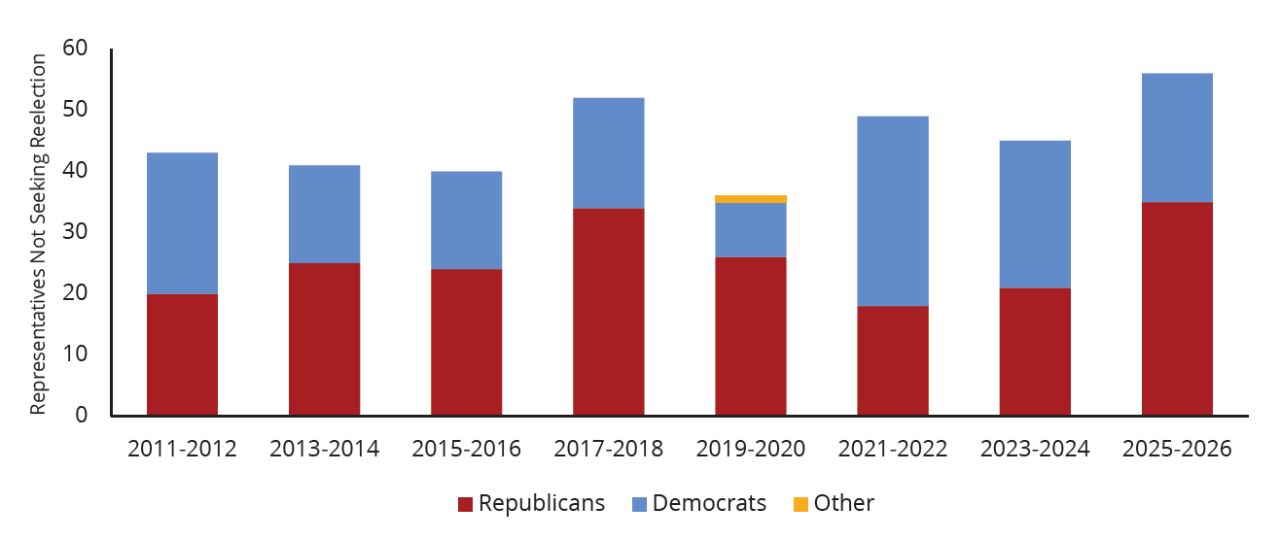
House retirements are emerging as an early warning sign ahead of the 2026 midterms. As of mid‑March, 56 House members have announced plans to retire or seek other offices (FIGURE 1). That tops the total seen in 2018, the last midterm cycle that cost Republicans control of the chamber, and puts 2026 on pace to challenge the modern record set in 1992.

FIGURE 1

House Retirements Are on the Rise Ahead of the Midterm Elections
Number of Representatives Not Seeking Reelection in 2026

As of 3/25/26. Data Sources: Ballotpedia and Axios.

Historically, elevated retirement rates tend to coincide with broader political headwinds. Open seats are more competitive, demand greater party resources, and often reflect lawmakers’ private assessments of the electoral environment. In this cycle, retirements appear less about individual transitions and more about structural challenges: a narrow House majority, legislative gridlock, difficult intraparty dynamics, and a national backdrop shaped by inflation sensitivity, foreign-policy strain, and trade uncertainty.

For Speaker Johnson, the implications are significant. Each departure reduces the margin for error, complicating efforts to advance a cohesive agenda and defend vulnerable districts simultaneously. The loss of incumbency advantages also forces House leadership to make harder trade-offs between governing priorities and political preservation as the campaign calendar accelerates.

While retirements alone don’t determine election outcomes, their scale and timing suggest rising caution within the Republican party. Combined with the policy pressures outlined above, they reinforce the view that 2026 is shaping up to be a highly contested midterm—with control of the House likely to hinge on a small number of competitive districts and the broader economic narrative unfolding between now and November.


Talk to your financial professional to help make sure your portfolio is prepared for whatever happens in Washington, D.C. 


1 US Energy Information Administration, “Amid Regional Conflict, the Strait of Hormuz Remains Critical Oil Chokepoint,” 6/15/25.

Investing involves risk, including the possible loss of principal. • Investments linked to prices of commodities may be considered speculative. • Foreign investments, including foreign government debt, may be more volatile and less liquid than U.S. investments and are subject to the risk of currency fluctuations and adverse political, economic and regulatory developments. These risks may be greater, and include additional risks, for investments in emerging markets.

The views and opinions expressed herein are those of the author, who is not affiliated with Hartford Funds. Hedgeye Potomac Research is not an affiliate or subsidiary of Hartford Funds.


POLWP035 5242335
About The Author
Author Headshot
Chief Political Strategist and Macro Policy Sector Head, Hedgeye Potomac Research