



• Products
  • Insights
  • Practice Management
  • Resources
  • About Us

Inheriting an IRA can feel overwhelming. Along with the emotional weight that often comes with a loved one’s passing, you’re suddenly faced with important financial decisions—many of them time sensitive—that can have lasting tax consequences.

The rules governing inherited IRAs have changed in recent years, and while the details can be complex, the core question is simple: What are your distribution options, and how do those choices affect your taxes and long-term financial picture?

The answer depends largely on who you are in relation to the original account owner. Under current law, IRA beneficiaries generally fall into one of three categories, each with its own set of rules and opportunities. Let’s look at how these beneficiary types work—and what they may mean for you.


1. Eligible Designated Beneficiaries: Flexible Options

Some beneficiaries are granted more flexibility under the law. Known as eligible designated beneficiaries, this group includes spouses, minor children of the account owner, individuals who are disabled or chronically ill, and beneficiaries who are not more than 10 years younger than the original owner. Spouses also have the option of rolling funds into their own IRAs.

Example:
Tom, 68, who was never married, names his younger brother Steve—just six years his junior—as the beneficiary of his IRA. When Tom passes away, Steve qualifies as an eligible designated beneficiary. Steve has several options:

  • Option A: He can withdraw the entire IRA immediately, recognizing the full amount as taxable income in the year of distribution.
  • Option B: He can take withdrawals over time, choosing when and how much to distribute, with each withdrawal taxed in the year it’s taken. He can make no contributions to the account, but any assets that remain can continue to potentially grow tax deferred. The account must be depleted within 10 years.
  • Option C: He can spread distributions—and mandatory required minimum distribution (RMD) withdrawals—over his own life expectancy, allowing the remaining assets to stay invested and potentially grow tax-deferred.

This last option is often appealing for beneficiaries who don’t need the money right away. It provides access when needed, while helping manage taxes and preserve long-term growth potential. If a beneficiary only withdrew the required minimum each year, the remainder could continue to grow tax-deferred.

 

The so-called 10-year rule requires the inherited IRA to be fully distributed by December 31 of the tenth year following the original owner’s death.


2. Non-Eligible Designated Beneficiaries: The 10-Year Rule

Most adult children and other non-spouse beneficiaries fall into the non-eligible designated beneficiary category. These beneficiaries are subject to the so-called 10-year rule, which requires the inherited IRA to be fully distributed by December 31 of the tenth year following the original owner’s death. Generally, beneficiaries will pay ordinary income taxes upon withdrawal on both the original inheritance and on any growth on that inheritance during the period the beneficiary holds the account.

Example:
Sally, age 70, names her 45-year-old daughter, Susie, as the beneficiary of her IRA. When Sally passes away, Susie becomes a non-eligible designated beneficiary. Susie’s options include:

  • Option A: Taking the entire balance immediately and paying taxes all at once.
  • Option B: Spreading distributions over several years—taking more in some years, less in others—as long as the account is fully depleted by the end of year 10.
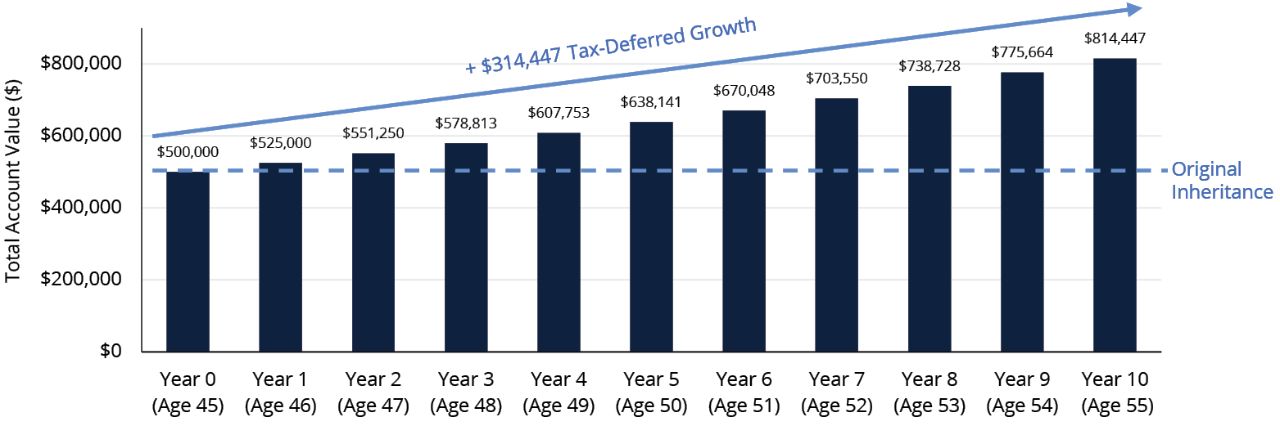
  • Option C: Deferring withdrawals entirely until the tenth year (FIGURE 1), allowing the assets to remain invested until then (with a potentially large taxable distribution at the end).


FIGURE 1

Non-Eligible Designated Beneficiaries Must Deplete Funds By the 10th Year
Hypothetical Tax-Deferred Growth of a $500K Inheritance If Allowed to Remain Invested

Hypothetical Tax-Deferred Growth of a $500K Inheritance If Allowed to Remain Invested

For illustrative purposes only. Assumes a 5% annual return. Not intended as tax or investment advice. Source: IRS Publication 590-B: Secure Act 10-year Distribution Rule.


One important nuance: If Sally had already begun taking her own required minimum distributions before she passed, Susie may also be required to take annual distributions in years one through nine, in addition to emptying the account by year 10.


3. Non-Designated Beneficiaries: Estates and Charities

When an IRA is left an estate or a charitable organization, different rules apply. These non-designated beneficiaries don’t have a life expectancy, so distribution options are more limited.

Example:
Harold Jackson, age 85, names his favorite charity as the sole beneficiary of his IRA. Because Harold had already begun taking required distributions, the remaining assets must generally be distributed within five years.

In this case, the executor could:

  • Distribute the entire IRA directly to the charity, or
  • Continue annual distributions over the five-year period (payable to the charity), as long as the account is fully depleted by the end of that timeframe.

For charitable beneficiaries, IRAs can be a particularly tax-efficient legacy tool, since qualified charities don’t pay income tax on distributions.


For charitable beneficiaries, IRAs can be a particularly tax-efficient legacy tool.


A Special Note on Roth IRAs

While the beneficiary rules are similar for Roth IRAs, the tax treatment can be very different. Because qualified Roth distributions are generally tax free, the ability to keep assets invested—especially for beneficiaries who don’t need immediate income—can significantly enhance long-term value.

For many families, this makes Roth IRAs an especially powerful asset to pass on, particularly to younger beneficiaries. While Roth IRA’s aren’t right for everyone, it may make sense to discuss you options with your financial professional.  It also may make sense to include your tax professional in the conversation and discuss “tax diversification” in addition to the investment diversification conversations you may already be having.


Why Beneficiary Designations Still Matter—A Lot

While this article focuses on what happens after an IRA is inherited, it’s worth stepping back to acknowledge an important reality: None of these options matter if beneficiary designations are missing, outdated, or incorrect.

Often, an old forgotten IRA account may not have a beneficiary listed. Or, perhaps, a beneficiary may be listed, but it’s the wrong beneficiary—a family member that has since passed away, a friend with whom you’ve lost touch, or a nonprofit that is no longer in existence. The list goes on and on.

Now is the time to take inventory. Review all your IRA accounts, find out where the accounts are located, and with whom. Think about consolidating these accounts to one location, with one financial professional, or, if they’re in multiple places, with multiple firms. Most importantly, ensure that the right beneficiary is listed.

Reviewing beneficiary designations regularly—and coordinating them with an overall estate and tax strategy—is one of the simplest yet most impactful planning steps an IRA owner can take.


Your financial professional can help you navigate inherited IRA distribution rules and align them with your estate and tax strategy.


Important Risks: Investing involves risk, including the possible loss of principal. 

All information provided is for informational and educational purposes only and is not intended to provide investment, tax, accounting or legal advice. As with all matters of an investment, tax, or legal nature, you and your clients should consult with a qualified tax or legal professional regarding your or your client’s specific legal or tax situation, as applicable. The preceding is not intended to be a recommendation or advice.

This information has been prepared from sources believed reliable but the accuracy and completeness of the information cannot be guaranteed. This material and/or its contents are current at the time of writing and are subject to change without notice. 

CCWP177 5535796
Insight from Hartford Funds
Managing Director, Applied Insights