


• Products
  • Insights
  • Practice Management
  • Resources
  • About Us

If it ain’t broke, don’t fix it, right? Since US stocks were crushing it for more than a decade, it seemed pointless to look anywhere else for return. But some of the advantages for US stocks may have shifted course, making now a good time to consider a more diversified approach going forward.

For years, interest rates and inflation were low, which favored growth stocks. Strong demand for smarter devices and online services also helped drive impressive outperformance for the tech-heavy US stock market—and for much longer than usual (FIGURE 1).

Then inflation hit multi-decade highs, and the Federal Reserve (Fed) raised US interest rates aggressively in response. This was a challenge for markets, but it may have also hit the reset button. For the first time in many years, value stocks repeatedly outperformed growth stocks abroad.

Can this reset last? We think it could. For starters, inflation can be difficult to truly tame. While it has slowed significantly from its peak, price pressures remain above the Fed’s target, and higher oil prices from the conflict in Iran may also prove inflationary. As a result, policymakers appear inclined to keep rates at relatively restrictive levels until they feel more confident that inflation is firmly under control.
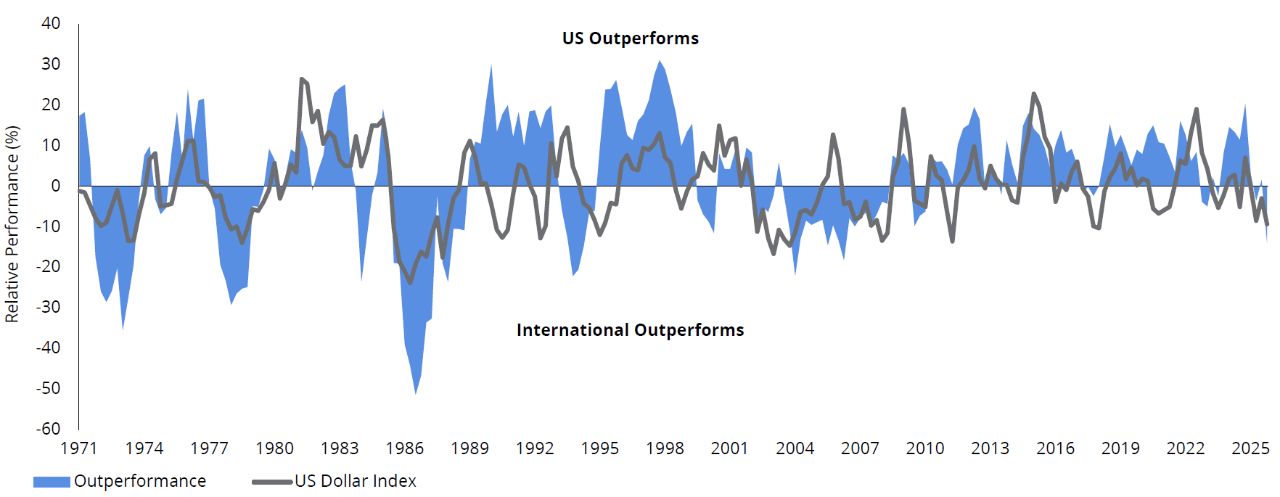
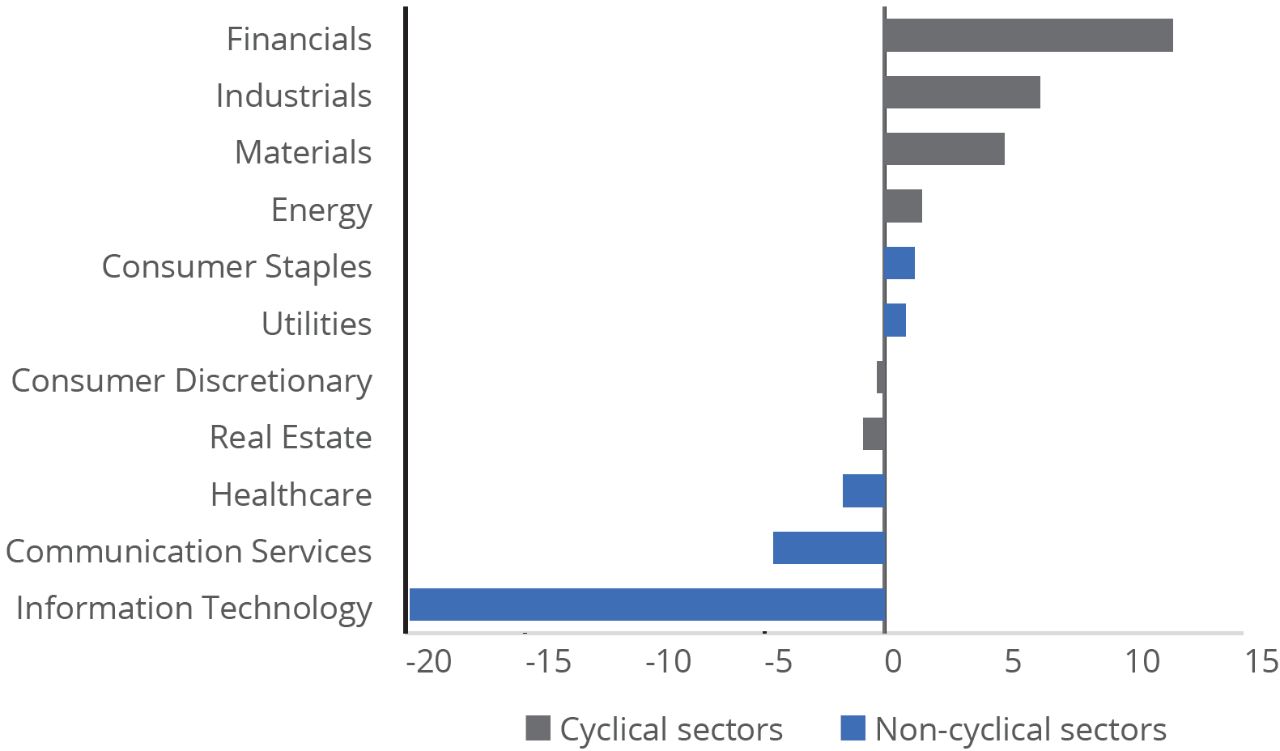
FIGURE 1

US and International Stocks Have Traded Periods of Outperformance
US Equity vs. International Equity (1-Year Rolling Quarterly Rolling Returns)

Mountain chart

As of 12/31/25. Past performance does not guarantee future results. The chart shows the S&P 500 Index’s returns minus the MSCI World ex USA Index’s returns. When the line is above 0, domestic stocks outperformed international stocks. When the line is below 0, international stocks outperformed domestic stocks. The performance shown above is index performance and is not representative of any Hartford Fund’s performance. Indices are unmanaged and not available for direct investment. Please see representative index definitions below. For illustrative purposes only. Data Sources: Morningstar, Bloomberg, and Hartford Funds, 2/26.

In the "new normal" of >2% inflation and elevated interest rates, a value tilt could benefit international stocks.   

How could that help international stocks? International markets have a noticeably different composition than the US, with greater exposure to cyclically oriented sectors. The international market, as represented by the MSCI ACWI ex USA Index, favors value-oriented cyclical sectors such as financials, materials, industrials, and energy. If inflation above 2% is the “new normal,” this value tilt could continue to benefit international markets. 

FIGURE 2

International Markets Have More Value Exposure Than the US
International Sector Weights Minus US Sector Weights (%)

Vertical bar chart

As of 12/31/25. International represented by the MSCI ACWI ex USA Index. US represented by the S&P 500 Index. Sources: FactSet and Hartford Funds.

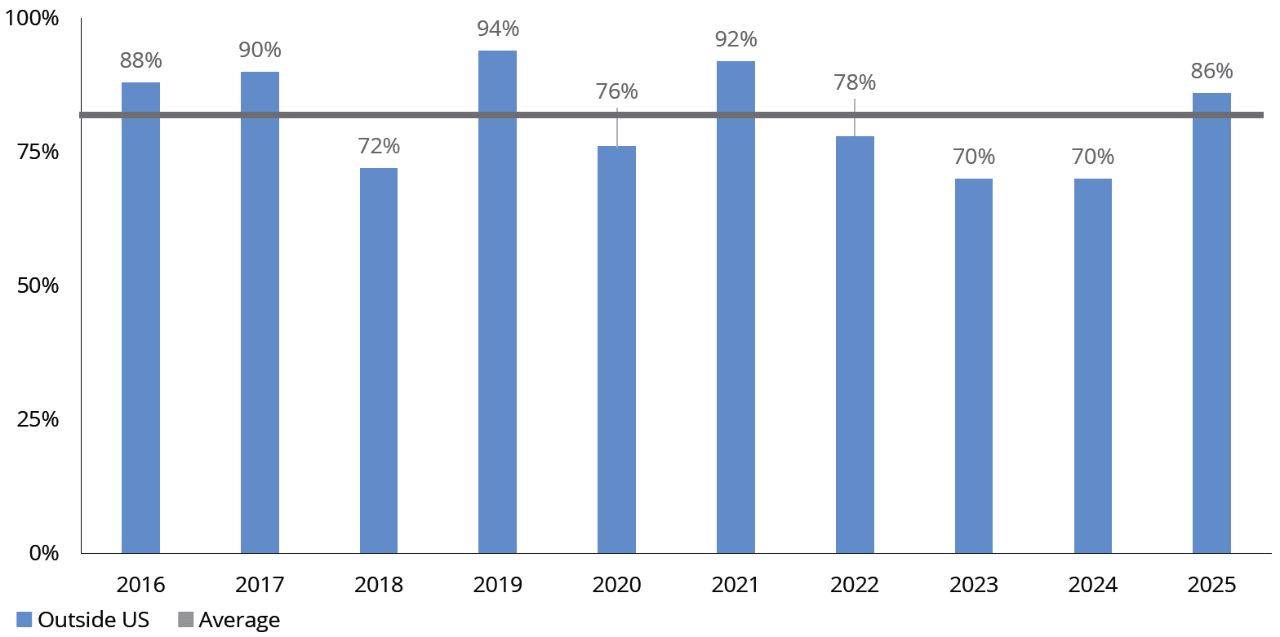
And international's outperformance shouldn't be all that surprising. As a group, international stocks were overshadowed by US stocks for much of the last decade. But on an individual basis, a significant majority of the best-performing companies in the world were already based outside the US during that same time frame (FIGURE 3).  

FIGURE 3

The US Isn’t Always Best
Percentage of World’s Top-50 Stocks That Were Non-US 

Bar Chart

As of 12/31/25. Past performance does not guarantee future results. Based on the annual calendar-year returns of the 50 highest-performing stocks of the MSCI ACWI Index. For illustrative purposes only. Data sources: FactSet and Hartford Funds, 2/26.


Where To Go From Here?

We’re not predicting that US stock performance will fall off a cliff, just that international markets may look more appealing as some things shift. We think international vs. US stocks isn't an either/or decision, but rather a both/and situation. For the best risk/reward tradeoff, a mix of about 60-70% US and 30-40% international has historically been a good combination. 

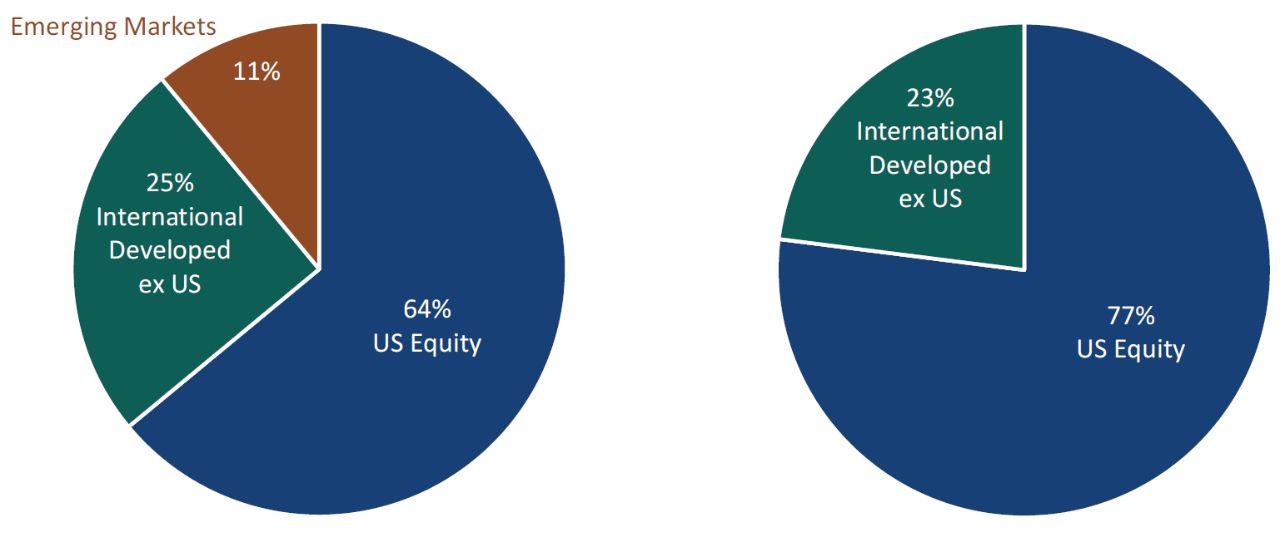
Since the US has outperformed for so long and by such a large margin, many investors may be particularly overweight US stocks and underweight international stocks today (FIGURE 4). This may not only leave investors underexposed to potential opportunity, but overexposed to the highly concentrated US market. 

Now may be a good time to re-evaluate your portfolio’s stock exposure.

FIGURE 4

US Investors Are Significantly Underweight International Stocks
MSCI ACWI Index vs. Average US Investor

The MSCI ACWI Index Allocates 36% to International Equities ...

... But the Average Investor Only Allocates 23% to International Equities..

Pie chart

As of 12/31/25. Data Sources: FactSet and Morningstar, 2/26. Ending values may differ from totals provided due to rounding.


In the wake of strengthening international equity performance, now may be a good time to re-evaluate your portfolio’s stock exposure. Maintaining a strategic international exposure with professional, active management could help you take advantage of the benefits international stocks may offer going forward. 


Talk to your financial professional about your portfolio’s exposure to international stocks. 


The US Dollar Currency Index (DXY) measures the relative value of the US dollar against a basket of other foreign currencies.
MSCI ACWI Index is a free float-adjusted market capitalization index that measures equity market performance in the global developed and emerging markets.
MSCI ACWI ex USA Index is a free float-adjusted market-capitalization index that measures the performance of both developed and emerging stock markets, excluding the United States.
MSCI World ex USA Index is a free float-adjusted market capitalization index that captures large- and mid-cap representation across developed markets countries excluding the United States. 
S&P 500 Index is a market capitalization-weighted price index composed of 500 widely held common stocks. 

Important Risks: Investing involves risk, including the possible loss of principal. • Foreign investments may be more volatile and less liquid than US investments and are subject to the risk of currency fluctuations and adverse political, economic, and regulatory developments. These risks may be greater, and include additional risks, for investments in emerging markets or if a fund focuses in a particular geographic region or country. • Different investment styles may go in and out of favor, which may cause underperformance to the broader stock market. • Diversification does not ensure a profit or protect against a loss in declining market.

The views expressed here are those of the author. They should not be construed as investment advice. They are based on available information and are subject to change without notice. This material and/or its contents are current as of the time of writing.

WP748 5301436

Insight from Hartford Funds
Author Headshot
Investment Specialist, International Equity