Pre-Sales Support
Mutual Funds and ETFs - 800-456-7526
Monday-Thursday: 8:00 a.m. – 6:00 p.m. ET
Friday: 8:00 a.m. – 5:00 p.m. ET
Post-Sales and Website Support
888-843-7824
Monday-Friday: 9:00 a.m. - 6:00 p.m. ET
Bond investors are used to dealing with uncertainty. But since 2022, 10-year Treasury yields have moved sharply higher, with sizable swings along the way (FIGURE 1). Even a one-percentage-point change in yields can translate into meaningful price changes for bonds, particularly longer-duration2 bonds. That sensitivity can make an uncertain rate environment difficult to navigate, especially as several forces contribute to continued swings in Treasury yields. Inflation remains stubborn, the Federal Reserve (Fed) is entering a new era, geopolitical risks are coming from several directions, and growing US borrowing needs are playing a larger role in the rate outlook. Together, these forces could make the path ahead particularly difficult to read.
Figure 1
Big Moves in Treasury Yields Have Persisted
Annual Range of 10-Year US Treasury Yields
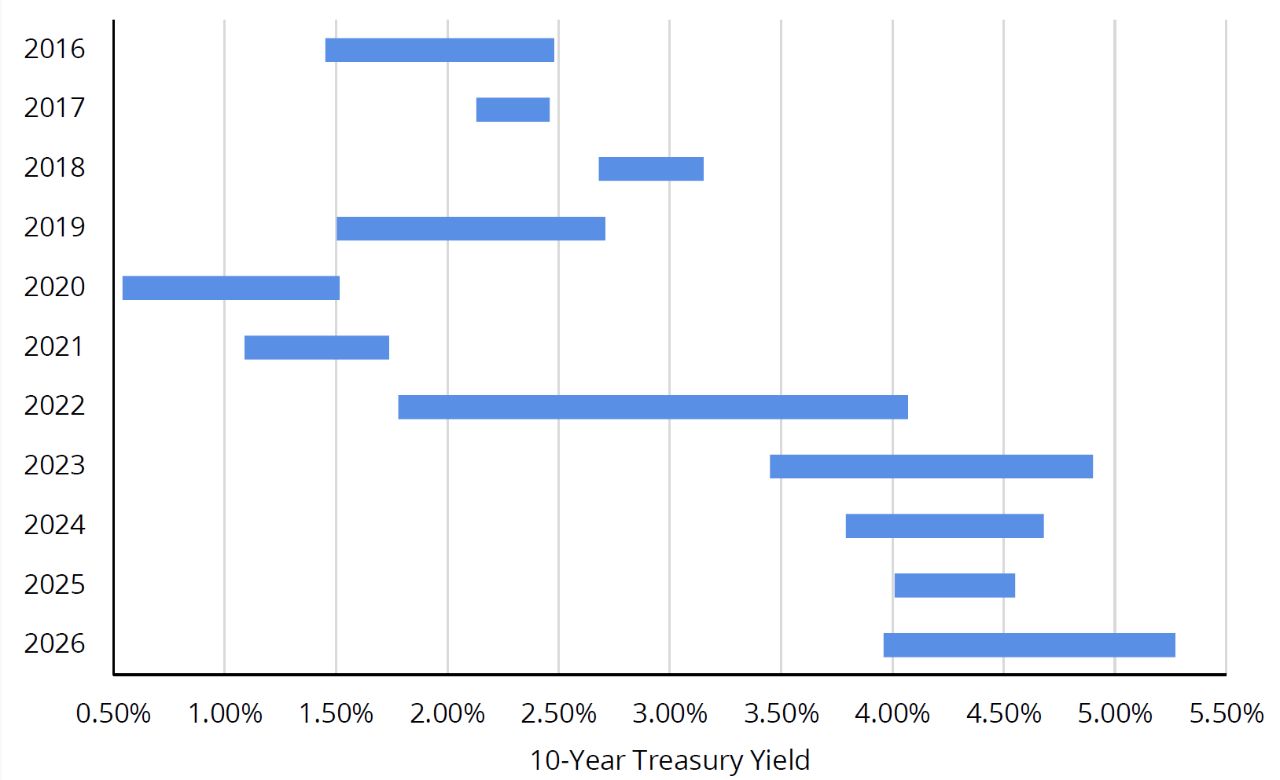
As of 10/31/26. Annual range is calculated as the difference between the highest and lowest monthly 10-year US Treasury yields observed during each calendar year. 2026 data are through 10/31/26. For illustrative purposes only. Source: FactSet, 11/26.
Four Factors Complicating the Bond Market
1. Persistent Inflation
Inflation has fallen considerably from its post-pandemic highs, but after five and a half years, it remains above the Fed’s 2% target. Persistent price pressures could keep rates higher for longer than markets expect, while a renewed pickup in inflation could quickly shift expectations for Fed policy. Investors may need to be prepared for a wider range of outcomes rather than assuming inflation will continue steadily lower.
2. Less Federal Reserve Transparency
For decades, the Fed has generally moved toward providing investors with more information about its thinking and where interest rates may be headed. Under new Fed Chair Kevin Warsh, that’s changing. Warsh has argued that too much communication can constrain policymakers and put undue emphasis on forecasts, and he’s begun scaling back some forms of forward guidance. That could leave markets with fewer clues about the Fed’s next move and add to uncertainty around the path of rates.
3. Heightened Geopolitical Risks
Geopolitical risks have become harder for investors to look past, too. Conflict in the Middle East has disrupted energy markets and key shipping routes, while trade tensions still cloud the outlook for global commerce. The implications for bonds aren’t always straightforward: Higher energy prices can fuel inflation, while weaker economic activity can pull in the other direction.
4. Fiscal Deficits, Debt, and Interest Costs
Years of persistent deficits have left the US with more debt to finance, and higher interest rates have made that debt more expensive to carry. Continued borrowing also means significant Treasury issuance, putting greater focus on whether investor demand can keep pace with supply. That dynamic could influence longer-term yields independent of where the Fed takes short-term rates.
More Uncertainty Calls for More Flexibility
All of this leaves the bond market without one obvious path forward. With inflation still an important consideration for monetary policy, rates and credit spreads have been volatile as markets digest the latest inflation data, economic news, and Fed signals. This creates a wider range of possible outcomes, and different environments may call for very different approaches.
When the outlook is uncertain, managers with the flexibility to adjust duration, move across sectors, and selectively take credit risk may have more ways to respond as conditions change. The next chapter for bonds may be less about predicting exactly what happens next and more about being prepared for what does.
To learn more about today’s opportunities in fixed income, talk to your financial professional.
1 Spreads are the difference in yields between two fixed-income securities with the same maturity but originating from different investment sectors.
2 Duration is a measure of the sensitivity of an investment’s price to nominal interest-rate movement.
Important Risks: Investing involves risk, including the possible loss of principal. • Fixed income security risks include credit, liquidity, call, duration, and interest-rate risk. As interest rates rise, bond prices generally fall.
This information should not be considered investment advice or a recommendation to buy/sell any security. In addition, it does not take into account the specific investment objectives, tax and financial condition of any specific person. This information has been prepared from sources believed reliable, but the accuracy and completeness of the information cannot be guaranteed. This material and/or its contents are current at the time of writing and are subject to change without notice.