Pre-Sales Support
Mutual Funds and ETFs - 800-456-7526
Monday-Thursday: 8:00 a.m. – 6:00 p.m. ET
Friday: 8:00 a.m. – 5:00 p.m. ET
Post-Sales and Website Support
888-843-7824
Monday-Friday: 9:00 a.m. - 6:00 p.m. ET
Today's fixed-income environment is one of the most compelling opportunities for income generation in years. Elevated yields are offering investors opportunities that were largely unavailable for more than a decade after the Global Financial Crisis, and though near-term volatility is likely to persist, it’s also creating entry points. For example, the recent rise in interest rates, exacerbated by geopolitical tensions in the Middle East, has further enhanced return expectations.
Higher Starting Yields May Improve Outcomes
Starting yield has historically been one of the strongest indicators of future return potential in fixed income. Today, yields across most fixed-income sectors are near the higher end of their historical ranges.
This also means that, in addition to a meaningfully improved opportunity to lock in higher levels of income, investors may have a greater cushion against price volatility.
Yields Across Almost All US Bond Market Sectors Are Near Historical Highs
Yields Ranked by Percentile Over the Past 10 and 20 Years (100th Percentile Is the Highest Yield Level)
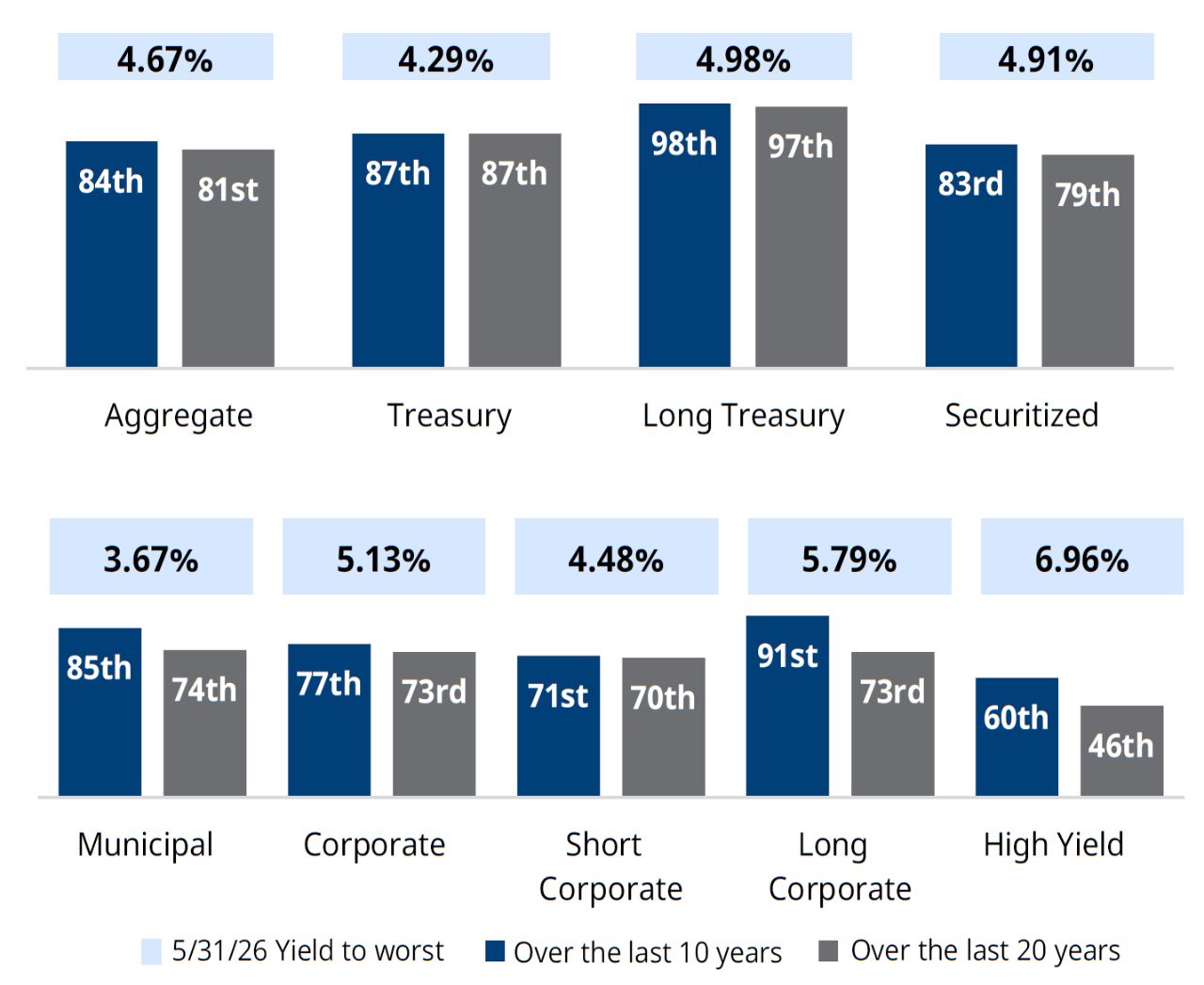
As of 5/31/26. Past performance is no guarantee of future results. Indices are unmanaged and not available for direct investment. Yield to worst is the minimum yield that can be received on a bond assuming the issuer doesn’t default on any of its payments See below for representative index definitions. Data Sources: LSEG DataStream and ICE BofA.
Volatility Can Be a Benefit, Not a Problem
Periods of rate volatility can be uncomfortable, but it’s important to remember that they can also create opportunities:
Rather than undermining fixed income’s role in portfolios, recent volatility has reinforced its potential as both a source of income and a tool for managing risk.
What This Means for Investors
The reset in yields has changed the math for investors. With yields now elevated across many sectors, fixed income once again can offer a meaningful source of income, a potential buffer against equity volatility, and a broader opportunity set for portfolio construction.
To learn more about today’s opportunities in fixed income, talk to your financial professional.
Aggregate: Bloomberg US Aggregate Bond Index is composed of securities that cover the US investment-grade fixed-rate bond market, with index components for government and corporate securities, mortgage pass-through securities, and asset-backed securities.
Corporates: Bloomberg US Corporate Index covers all publicly issued, fixed-rate, nonconvertible, investment-grade debt.
High Yield: Bloomberg US High Yield Index measures the USD-denominated, high-yield, fixed-rate corporate bond market.
Long Corporate: Bloomberg US Long Corporate Index measures the investment-grade, fixed-rate, taxable corporate bond market.
Long Treasury: Bloomberg US Long Treasury Index is an index of all publicly issued long-term government debt securities. Average maturity is 23–25 years.
Municipals: Bloomberg Municipal Index is designed to cover the USD-denominated long-term tax-exempt bond market.
Securitized: Bloomberg US Securitized Index is a market-value-weighted index that tracks the performance of investment-grade, US-dollar-denominated securitized debt, including agency mortgage-backed securities (MBS), asset-backed securities (ABS), and commercial mortgage-backed securities (CMBS).
Short Corporate: ICE BofA US Corporate 1–3 Year Index tracks the performance of USD-denominated investment-grade rated corporate debt publicly issued in the US domestic market with a remaining term to maturity of less than 3 years.
Treasuries: Bloomberg US Treasury Index is an unmanaged index of prices of US Treasury bonds with maturities of one to 30 years.
Important Risks: Investing involves risk, including the possible loss of principal. • Fixed income security risks include credit, liquidity, call, duration, and interestrate risk. As interest rates rise, bond prices generally fall. • Investments in high-yield (“junk”) bonds are considered speculative, involve heightened credit risk and greater risk of price volatility, illiquidity, and default than investment grade bonds. • Municipal securities may be adversely impacted by state/local, political, economic, or market conditions. • US Treasury securities are backed by the full faith and credit of the US government as to the timely payment of principal and interest. • Diversification does not ensure a profit or protect against a loss in declining market.
This information should not be considered investment advice or a recommendation to buy/sell any security. In addition, it does not take into account the specific investment objectives, tax and financial condition of any specific person. This information has been prepared from sources believed reliable, but the accuracy and completeness of the information cannot be guaranteed. This material and/or its contents are current at the time of writing and are subject to change without notice.