



• Products
  • Insights
  • Practice Management
  • Resources
  • About Us

When it comes to building long-term wealth, starting early is one of the most powerful moves a family can make. A child born today has decades before traditional retirement age, which means decades of potential compounding and growth, even with modest contributions.

If you have children under 18, there are two main account types to consider to give your child an early start on their retirement savings: Trump Accounts, which are new and only available as of 2026, and custodial IRAs.

Both are designed to give children an early start on retirement savings via long-term growth. Understanding the similarities and differences between the two types of accounts can help you choose the right fit for your family.


What They Have in Common
Trump accounts and custodial IRAs share some common traits:

  • You’re in charge—for now. As a parent or guardian, you manage the account on your child’s behalf until they reach adulthood. For Trump Accounts, control transfers at age 18 under federal law. For custodial IRAs, it depends on your state’s age of majority, which is either 18 or 21.
  • The earlier, the better. Both accounts are structured to give your child the full benefit of long-term, tax-advantaged growth, and the earlier you start, the more time compounding has to work.
  • Both can be a group effort. Parents, grandparents, and other family members can help contribute to either account, up to certain limits.

As much as they have in common, the differences between the account types could be what makes or breaks your decision. The side-by-side view below can help you compare the key differences between the types of accounts.

How Trump Accounts and Custodial IRAs Differ

 
  Trump Account Custodial IRA
Who Is Eligible? Minors Minors with earned income
2026 Annual
Contribution
Limit
$5,000 $7,500 or the beneficiary’s earned income amount, whichever is lower
Earned Income
Required?
No Yes
Investment
Options
Low-cost index funds or ETFs with at least 90% domestic holdings until the account converts at age 18 Broader range of investment options
Tax Treatment Tax-deferred A traditional IRA grows tax-deferred; a Roth IRA grows tax-free
What Happens
at Age 18
Converts to a traditional IRA Remains as set up (Traditional or Roth IRA)
Withdrawals 
Before Age 59 ½
No withdrawals allowed during growth period from age 0-17; withdrawals before age 59 ½ penalized at 10% and taxed as income, with exceptions for qualified expenses Traditional IRA: Penalized at 10% and taxed as income, with exceptions for qualified expenses; Roth contributions can be withdrawn at any time tax- and penalty-free, but withdrawing earnings before 59 ½ may trigger taxes and 10% penalty
Seed Money

From the US government: $1,000 for children born 2025–2028, does not count toward annual limit

From Michael and Susan Dell: $250 for eligible children under 10 in qualifying zip codes.

None
Employer
Contributions
Allowed up to $2,500, tax-free (counts toward the $5,000 annual limit) None

Sources: Investor.gov, US Bank, Trumpaccounts.gov. Trump Account details are based on current legislation and IRS guidance, which may be updated.


Tax Advantages: Roth vs. Traditional IRA for Kids

If you’re considering a custodial IRA, you’ll need to decide whether to open it as a Roth or traditional account. For most children, a Roth IRA may be worth a close look. Why? Roth contributions are made with after-tax dollars, but the money grows tax-free and can be withdrawn tax-free in retirement.

Because most children are in a very low (or even zero) tax bracket, they’re often in an ideal position to take advantage of Roth benefits right now, paying little or no tax today in exchange for tax-free growth over the next several decades.

Trump Accounts, by contrast, are tax-deferred and convert to a traditional IRA at age 18. Contributions from family members are made with after-tax dollars, so only the earnings are taxed upon withdrawal. The government seed money and employer contributions are fully taxable when withdrawn, since they went in pretax.


There’s no right or wrong answer to which account is better, but you may find that one is a better fit for your current situation. 


Which One Is Right for Your Child?

There’s no right or wrong answer to which account is better, but you may find that one is a better fit for your current situation.

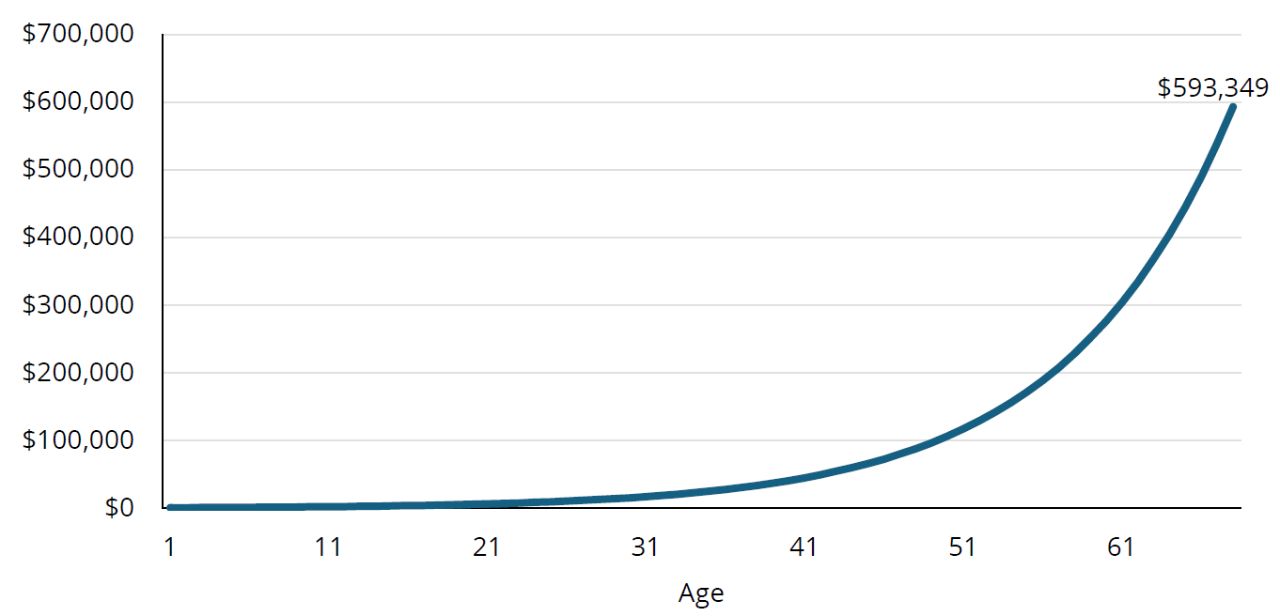
For example, Baby Johanna was born in 2026 and because she has no earned income, a Trump Account may make sense. Whether or not her family continues to make contributions over the years, the $1,000 in government seed money could quietly compound for decades, growing significantly by retirement. 


With Compounding, A Child Could Have a Sizeable Nest Egg by Retirement
Growth of $1,000 at Average Stock-Market Return Rate

Hypothetical growth for a child eligible for the $1,000 seed investment for a Trump Account. Assumes no additional contributions and a 10% investment return each year through age 67 with no withdrawals prior to retirement. The hypothetical 10% annual rate is not guaranteed and does not reflect the performance of any particular investment. Actual returns may vary based on market conditions and any applicable fees or expenses.  Source: Hartford Funds.


Additionally, Johanna’s mom works for a company that offers $2,500 contributions per employee toward Trump Accounts. Mom is able to contribute another $2,500 to reach Johanna’s $5,000 annual maximum. And since Trump Accounts are required to offer a default investment option, it’s not overwhelming to start saving for Johanna’s retirement from day one, even though mom doesn’t have a lot of investment experience.

On the other hand, a teen with a part-time or summer job may benefit more from a custodial IRA since the contribution limits are higher. And since family members can contribute to a custodial IRA, a financially savvy parent or grandparent could offer to match their income, too.

For example, Noah expects to earn at least $7,500 at his summer job this year, but doesn’t want to invest it all so he still has some spending money to use with his friends. Noah’s grandfather wants to help him learn good long-term financial habits, so he offers to go halves and “match” Noah’s investment; they each contribute $3,750 to reach the $7,500 annual maximum. Conversely, Noah’s grandfather could also contribute the full $7,500 and let Noah keep all his summer earnings—the key is that in either situation, Noah must declare the $7,500 on his taxes as earned income in order for anyone to contribute to the account. 


How to Get Started

If a Trump Account is the best fit for your child, you can apply by filling out IRS Form 4547 (which you may have also filled out while filing your 2025 taxes) and sign in or register for an IRS account by visiting IRS.gov or trumpaccounts.gov. The accounts officially launch on July 4, 2026.

If you decide a custodial IRA is the best fit for you, your financial professional can help you decide which type makes the most sense and narrow down your options to get started. 


Let Time Work for You

No matter which account you choose, the most important move is getting started. Time in the market is one of the most valuable gifts you can give your child: The earlier you begin, the more of that gift they receive. Ask your financial professional for more details on how your child could benefit from getting an early start on retirement savings.


Talk to your financial and tax professional about the right type of investment account to give your child a retirement-savings headstart. 


Important Risks: Investing involves risk, including the possible loss of principal.

This information should not be considered investment or tax advice or a recommendation to buy/sell any security. In addition, it does not take into account the specific investment objectives, tax, and financial condition of any specific person.

This information has been prepared from sources believed reliable but the accuracy and completeness of the information cannot be guaranteed. This material and/or its contents are current at the time of writing and are subject to change without notice.

CCWP180 5580481