



• Products
  • Insights
  • Practice Management
  • Resources
  • About Us

symbol

40%

of older Americans don’t understand their Medicare options while working.1

Turning 65 is an important Medicare milestone but deciding whether and when to enroll isn’t always straightforward, especially if you’re still working. Do you need to enroll right away? Can you delay coverage? Are there penalties if you don’t?

The decision depends on factors such as your employment status and employer-sponsored health coverage. Understanding the rules can help you avoid unnecessary costs and coverage gaps while ensuring you have the coverage you need.


Do I Need to Enroll in Medicare?

Knowing whether you need to enroll in Medicare at age 65 is the first step. Here are some questions to ask yourself as you consider your options:2

  • Do I work for a company with 20 or more employees?

    Employer size can play an important role in your Medicare enrollment decision. If you’re 65 or older and work for an employer with 20 or more employees, you can generally stay on your employer-sponsored health plan and delay enrolling in Medicare.

    If your employer has fewer than 20 employees, Medicare typically becomes your primary coverage at age 65. Delaying enrollment may lead to coverage gaps and permanent late enrollment penalties.*

  • Do I want to continue contributing to a Health Savings Account (HSA)?

    If you enroll in any part of Medicare, you can no longer contribute to a Health Savings Account (HSA). However, you can keep the money in your account and continue using it for qualified medical expenses.

    For people who are still working, HSA contributions can be an important part of their overall savings strategy. If you’re eligible to delay Medicare enrollment, consider how important ongoing HSA contributions are to you.

    Keep in mind: If you’re receiving Social Security benefits when you become eligible for Medicare, you may be automatically enrolled in Medicare. If continuing to contribute to an HSA is important to you, be sure you understand how Medicare enrollment could affect those contributions.

  • Is Medicare Actually the Better Option? 

    If you’re eligible to delay Medicare enrollment, your decision may come down to how your employer-sponsored health coverage compares to Medicare. If you think Medicare may offer a better fit, ask yourself:

    • How do your premiums, deductibles, and out-of-pocket costs under your employer plan compare to Medicare?
    • Are your preferred doctors, hospitals and other providers covered?
    • Does one option offer benefits or coverage that are especially important to you?

    No matter when you plan to enroll, the next step is understanding your coverage options.


Understanding Your Medicare Coverage Options

Whether you enroll in Medicare at age 65 or later, it’s helpful to become familiar with the different parts of Medicare, what they help cover, and how you can receive your benefits. Traditional Medicare is not one single insurance plan; it’s made of different parts that cover different needs:

  • Part A (Hospital Insurance): Inpatient hospital care, skilled nursing-facility care, hospice care, and some home health care

  • Part B (Medical Insurance): Doctor visits, outpatient care, medical equipment, and many preventative services

  • Part D (Drug Coverage): Prescription-drug costs

When you enroll, you generally have two main ways to receive your Medicare benefits:

  • Traditional Medicare includes Parts A and B. It can be supplemented with a standalone Part D prescription-drug plan and a Medicare Supplement Insurance (Medigap) policy to help cover certain out-of-pocket costs.

  • Medicare Advantage (Part C) is an alternative to Original Medicare offered by private, Medicare-approved insurers. It includes Part A and Part B benefits, usually includes Part D drug coverage, and may offer additional benefits. Plans generally use provider networks and may have specific rules for receiving services.

Seeing how these options apply in real-life situations can make the decision-making process easier.


Real-Life Medicare Choices

Linda is single, 65, and works for a company with more than 20 employees. She likes her employer’s health benefits, but her premiums and out-of-pocket costs keep climbing, and she’s wondering if she has better options.

Linda’s Choice:

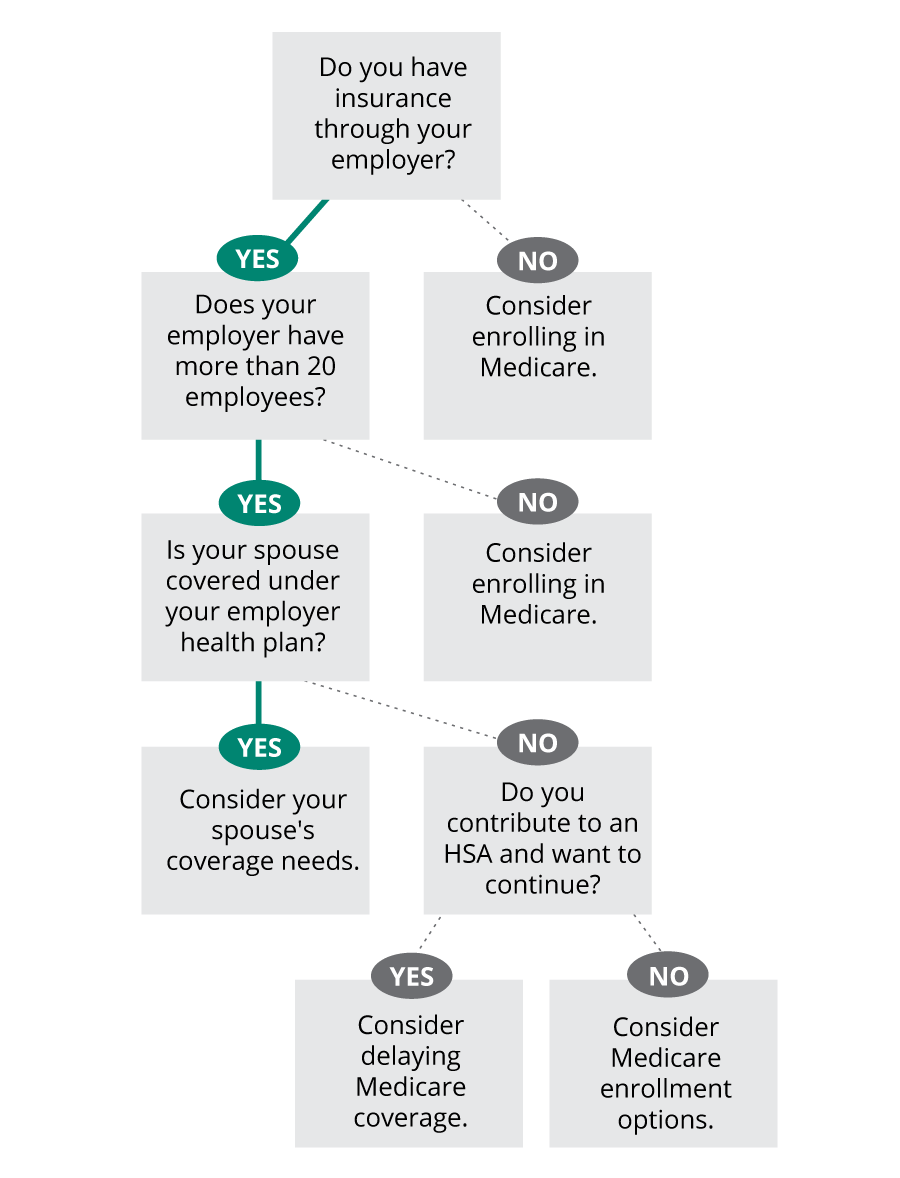
When she compares her employer plan to Medicare, the coverage looks pretty similar. The big difference is cost. Both Traditional Medicare and Medicare Advantage would run significantly less than what she’s paying now. Because she isn’t contributing to an HSA, she has the flexibility to make a change whenever it makes sense.

Follow the highlighted path to see how Linda arrived at her Medicare decision.
symbol

40%

of older Americans don’t understand their Medicare options while working.1

Linda’s Path

Linda decided to enroll in Medicare Advantage. The coverage met her needs, cost less than her employer plan, and she liked the convenience of having her medical and prescription drug coverage bundled in one plan.

Now let’s look at David

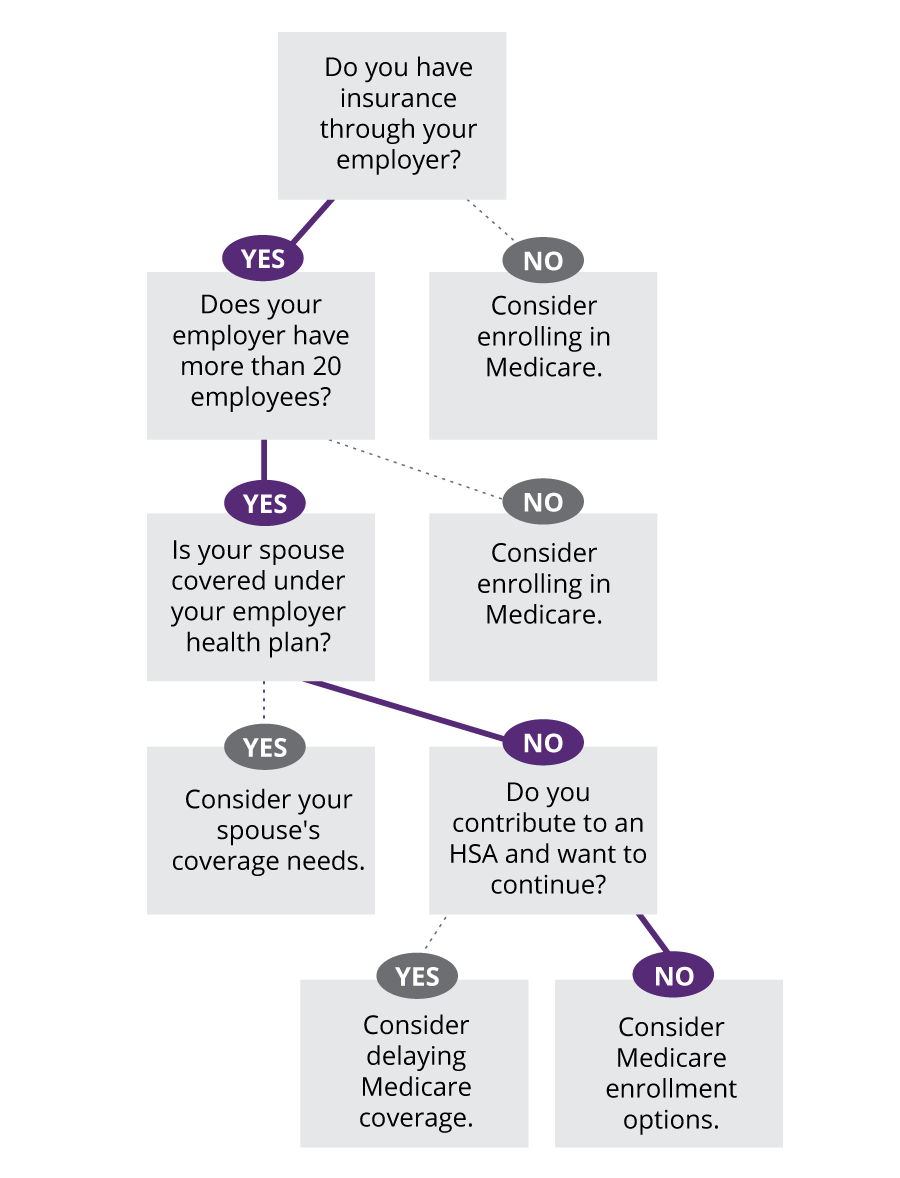
David is 65 and plans to keep working until age 68. His 62-year-old wife is covered by his employer plan, and he contributes to an HSA. Because his company has more than 20 employees, David can stay on the plan while he continues working. But with premiums rising and fewer providers to choose from, he’s wondering whether his current coverage still meets his needs.

David’s Choice:

Although Medicare had some appeal, David decided to stay with his employer plan for now. This allows him to continue contributing to his HSA and maintain his wife’s coverage under the plan until she’s eligible for Medicare. If he switched to Medicare now, she might need to find separate coverage.

Follow the highlighted path to see how David arrived at her Medicare decision.


David’s Path

As Linda’s and David’s examples show, the choice often depends on factors such as employer coverage, family circumstances, healthcare needs, and retirement plans.

Tip: You don’t have to sort through your Medicare options alone. State Health Insurance Assistance Programs (SHIPs) offer free, local, unbiased guidance as you explore Medicare, compare plans, and make informed decisions.

“Why Does Medicare Even Matter If I’m Keeping My Employer Coverage?” Honestly? It might not. But then again, it might, especially if your employer has fewer than 20 employees or you like contributing to an HSA. In those cases, when and whether you enroll can have real consequences, so it’s worth paying attention.


Summary

First, know the rules about whether you need to enroll in Medicare at 65. If your employer has 20 or more employees, you may be able to delay. Second, when it’s time to enroll, compare Traditional Medicare and Medicare Advantage to determine which option better aligns with your needs. Lastly, evaluating your options early can help you avoid coverage gaps and preserve benefits that matter to you.


Next step:

Talk with your employer’s benefits team or a SHIP counselor to understand your Medicare options.


* Late-enrollment penalties can apply to Medicare Part B. The Part B penalty generally increases your monthly premium by 10% for each full 12-month period you were eligible but didn’t enroll when required. Rules for Medicare Part A differ, and individuals covered by a qualifying employer health plan may be able to delay enrollment without penalty.

Author Headshot

Curtis is a senior internal advisor consultant for Hartford Funds. He’s responsible for marketing Hartford Funds and The Hartford SMART529. He supports financial professionals and their clients with educational materials, product expertise, and practice-management strategies. He holds his National Social Security Advisor Certificate and is committed to educating professionals and their clients on social security-related topics.

1 With Retirement Delayed for Many, New Study Finds 40% of Older Americans Don't Understand Options for Medicare While Working,Allsup, July 27, 2022. Most recent data available.

2 Medicare.gov, 2026

This information does not take into account the specific tax and financial condition of any specific person. This information has been preparedfrom sources believed reliable but the accuracy and completeness of the information cannot be guaranteed. This material and/or its contentsare current at the time of writing and are subject to change without notice.

All information provided is for informational and educational purposes only and is not intended to provide investment, tax, accounting or legaladvice. As with all matters of an investment, tax, or legal nature, you should consult with a qualified tax or legal professional regarding yourspecific legal or tax situation, as applicable.

Hartford Funds is not responsible for, and does not validate, any information, opinions, assertions, or statements expressed within thesearticles, or the identity or credentials of the individuals communicating in this paper.


6009465

The material on this site is for informational and educational purposes only. The material should not be considered tax or legal advice and is not to be relied on as a forecast. The material is also not a recommendation or advice regarding any particular security, strategy or product. Hartford Funds does not represent that any products or strategies discussed are appropriate for any particular investor so investors should seek their own professional advice before investing. Hartford Funds does not serve as a fiduciary. Content is current as of the publication date or date indicated, and may be superseded by subsequent market and economic conditions.

Investing involves risk, including the possible loss of principal. Investors should carefully consider a fund's investment objectives, risks, charges and expenses. This and other important information is contained in the mutual fund, or ETF summary prospectus and/or prospectus, which can be obtained from a financial professional and should be read carefully before investing.

Mutual funds are distributed by Hartford Funds Distributors, LLC (HFD), Member FINRA|SIPC. ETFs are distributed by ALPS Distributors, Inc. (ALPS). Advisory services may be provided by Hartford Funds Management Company, LLC (HFMC) or its wholly owned subsidiary, Lattice Strategies LLC (Lattice). Certain funds are sub-advised by Wellington Management Company LLP and/or Schroder Investment Management North America Inc (SIMNA). Schroder Investment Management North America Ltd. (SIMNA Ltd) serves as a secondary sub-adviser to certain funds. HFMC, Lattice, Wellington Management, SIMNA, and SIMNA Ltd. are all SEC registered investment advisers. The funds and other products referred to on this Site may be offered and sold only to persons in the United States and its territories.

Hartford Funds refers to HFD, Lattice, and HFMC, which are currently not affiliated with any sub-adviser or ALPS.

On June 3, 2026, The Hartford Insurance Group, Inc. (“The Hartford”) and Wellington announced that they had reached a definitive agreement under which Wellington Investment Advisors Holdings, LLP, Wellington’s corporate parent, will acquire Hartford Funds. Upon closing Hartford Funds will be integrated into Wellington’s U.S. Wealth business. The deal is expected to close in the first quarter of 2027, subject to regulatory and fund approvals. Upon closing, Hartford Funds would become an affiliate of Wellington. For more information, click here.

© Copyright 2026 Hartford Funds Management Group, Inc. All Rights Reserved. Not FDIC Insured | No Bank Guarantee | May Lose Value