Pre-Sales Support
Mutual Funds and ETFs - 800-456-7526
Monday-Thursday: 8:00 a.m. – 6:00 p.m. ET
Friday: 8:00 a.m. – 5:00 p.m. ET
Post-Sales and Website Support
888-843-7824
Monday-Friday: 9:00 a.m. - 6:00 p.m. ET
By 62, Mark was burned out after years as a project manager in commercial construction. The work had been rewarding, but relentless: long hours, constant deadlines, and frequent travel to job sites.
Lately, he’d been seeing-social media posts promoting early Social Security claiming as a smart—or even “optimized”—move. Start benefits sooner. Get paid while you can. Maybe even come out ahead. It sounded like a no-brainer. Why wait to collect benefits you’ve spent a lifetime earning?
Much of the argument centered on a Social Security “break-even” age. If claiming benefits five years ahead of his full retirement age immediately puts more money in his pocket, claiming early seemed difficult to argue against. But focusing on the break-even point alone may oversimplify a much more complex decision.
First, What Is a Break-Even Age
On the surface, the case for early Social Security claiming can seem straightforward: claiming earlier means you begin collecting benefits sooner, while delaying increases your monthly benefit but requires you to forgo payments in the meantime. It appears to boil down to a choice between more checks or larger checks.
This is where “break-even” comes in. It’s the age at which the cumulative benefits from delaying catch up to the cumulative benefits you would have received by claiming early. At that point, the two claiming strategies have produced the same total benefits.
Many Retirements Last 20 Years or More
Average life expectancy for a 65-year-old today

Source: Social Security Administration Actuarial Life Table (2023 mortality rates), as used in the 2026 Trustees Report. Ages shown are rounded estimates for individuals age 65.
As the chart below illustrates, claiming early gives Mark a head start. By claiming at age 62, Mark begins receiving $2,822 per month. If he instead waits until age 67, he forgoes benefits during those five years, but his monthly benefit increases to $4,155. Over time, those larger payments begin to narrow the gap, eventually catching up to the cumulative benefits he would receive from claiming early. In this example, that crossover—or break-even point—occurs at about age 78, when both options have reached approximately $526,000.
After the break-even age, the advantage of delaying continues to grow.
By age 85, the gap reaches nearly $119,000. By age 90, it reaches almost $199,000.
If Mark lives only to age 68, claiming at 62 would leave him with more cumulative Social Security benefits than if he had waited until age 67. It would also provide income during the five years he otherwise would have spent waiting to claim, which may be an important consideration depending on his health, financial needs, and retirement goals.
Viewed through this lens, the decision may seem straightforward: Claim early if you don’t expect to reach the break-even age, and delay if you expect to live well beyond it. But that conclusion assumes the break-even analysis captures the full picture—and it doesn’t.
What Happens After the Break-Even Age?
At age 78, cumulative benefits are roughly equal. Beyond that point, the advantage of delaying continues to grow.
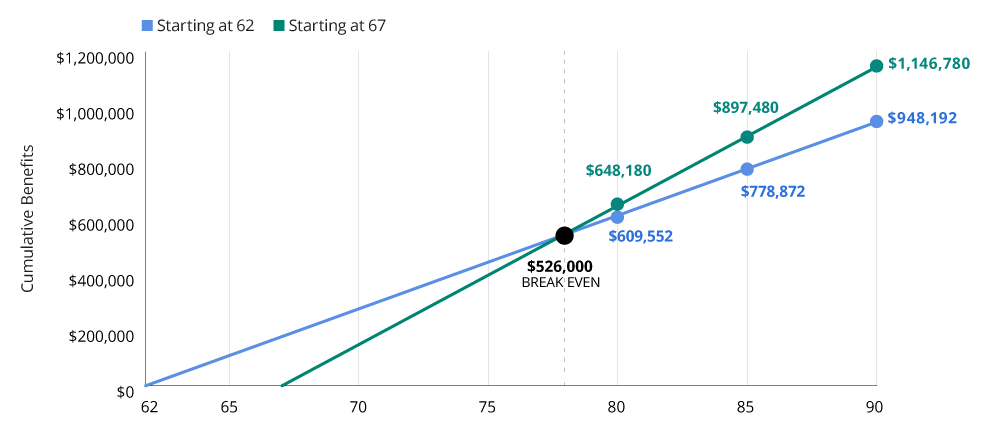
Hypothetical example for illustrative purposes only. Assumes monthly benefits of $2,822 at age 62 and $4,155 at age 67. Figures are cumulative benefits received and exclude taxes, COLAs, and investment returns.
Note: There are also online calculators that can estimate your break-even age. These can be helpful for visualizing the trade-offs—but they’re based on assumptions and don’t account for factors like taxes, longevity, or spousal benefits.
Second, What Break-Even Analysis Leaves Out
Break-even analysis focuses on when delaying benefits begins to pay off, but it leaves out several considerations that can significantly affect the decision.
Your claiming decision can affect a surviving spouse
Break-even analysis typically focuses on the benefits received by one individual. But for married couples, the decision may also affect a surviving spouse. If the higher earner claims early and receives a reduced benefit, the survivor benefit might be reduced as well. For a married couple, both age 65, there’s approximately a 50% chance that at least one spouse will live beyond age 92.1
A larger benefit can mean larger future COLAs
Social Security benefits are typically adjusted through cost-of-living adjustments (COLAs), which are intended to help keep pace with inflation. Because those adjustments are applied as a percentage of your benefit, delaying and receiving a larger benefit may result in larger dollar increases over time.
Taxes could come into play
Depending on your total income, up to 85% of your benefits may be taxable. The timing of your claim should be coordinated with withdrawals from retirement and investment accounts, Roth conversions, and Medicare premiums to help manage taxes and overall income.
Working while claiming early may reduce benefits
If you claim benefits before full retirement age and continue working, your benefits may be reduced further if your earnings exceed certain limits. This can also push out the break-even point.
Third, How to Approach the Decision
For many retirees, breaking even isn’t the true goal; it’s creating reliable income throughout retirement. A more useful question may be how Social Security fits into your broader retirement-income strategy.
Even if you won’t depend heavily on Social Security, when you claim still matters. Collecting a larger benefit later could help cover rising costs of healthcare, or it could be used for things like travel, hobbies, or helping fund a grandchild’s education.
It may also give you more flexibility in deciding when and how to draw from your portfolio so you can conserve those assets.
Factors to consider:
Do you want to increase the portion of your income that’s guaranteed for life?
Delaying benefits can create a larger, inflation-adjusted income stream, which may also result in a higher benefit for a surviving spouse.
Can you coordinate filing with your spouse?
One approach is for the lower-earning spouse to claim earlier to provide income in the near term, while the higher earner delays to build a larger benefit over time.
Do you want to minimize taxes on retirement income?
When and how you draw income in retirement matters. Coordinating Social Security with withdrawals from retirement and investment accounts may help improve tax efficiency over time.
Will you continue to work?
Your current income may give you the flexibility to wait, allowing your benefit to grow while preserving other assets for future use. From this perspective, Social Security becomes less about a single decision and more about how you structure income across different stages of retirement.
The Question Is Bigger Than Break-Even
Mark wasn’t just deciding when to claim. He was deciding whether the income he needed today was worth trading off against what he might need 20 years from now.
Because no two retirements look alike, there’s no universal claiming strategy. Factors such as longevity, taxes, spousal benefits, and how you plan to draw from your portfolio can influence the decision. In the end, the most important question may not be whether you’ll reach a break-even age, but how Social Security fits into the retirement-income plan you want to build.
Next Steps
Start by downloading your Social Security statement (and your spouse’s, if applicable), which shows your estimated benefits at different claiming ages
Meet with your financial and tax professionals to discuss how different claiming strategies fit into your overall income plan and goals

Mike is a managing director of the Hartford Funds Applied Insights Team. The team translates the expertise of the psychologists, physiologists, professors, and practice-management experts we partner with into practical, actionable ideas and tools to make sense of a rapidly evolving market and demographic landscape.
1 Social Security Break-Even Age & Life Expectancy Chart, Benefora, 3/26
All information provided is for informational and educational purposes only and is not intended to provide investment, tax, accounting or legal advice.
As with all matters of an investment, tax, or legal nature, you should consult with a qualified tax or legal professional regarding your specific legal or tax situation, as applicable.