


• Products
  • Insights
  • Practice Management
  • Resources
  • About Us

What if AI is not simply the next great technology cycle, but a macroeconomic shock on the scale of China’s rise? Comparisons with railways, telecommunications, and the internet help illustrate how quickly AI could spread. But China’s integration into the global economy may offer a more powerful framework for understanding the breadth of the disruption ahead.

Like China’s ascendency, AI could reshape energy demand, capital investment, productivity, labor markets, and national competitiveness—while producing winners and losers in unexpected places. For investors, the comparison offers important lessons about how AI’s influence on markets and portfolios may unfold over time.

1. Look Beyond the Obvious Winners

China’s emergence on the global stage was the most significant macroeconomic development of the first quarter of this century. Its admission to the World Trade Organization effectively added nearly a billion workers to the global workforce. This labor-supply shock dramatically increased manufacturing capacity while raising standards of living in China and around the world. Falling goods prices contributed to disinflation and, ultimately, higher global profits.

China’s industrialization also fueled a commodity supercycle and a prolonged bond bull market, as disinflation reduced the need for central banks to raise interest rates. Over time, China’s rise benefited commodity producers, industrial companies, infrastructure providers, exporters, and, eventually, consumer businesses.

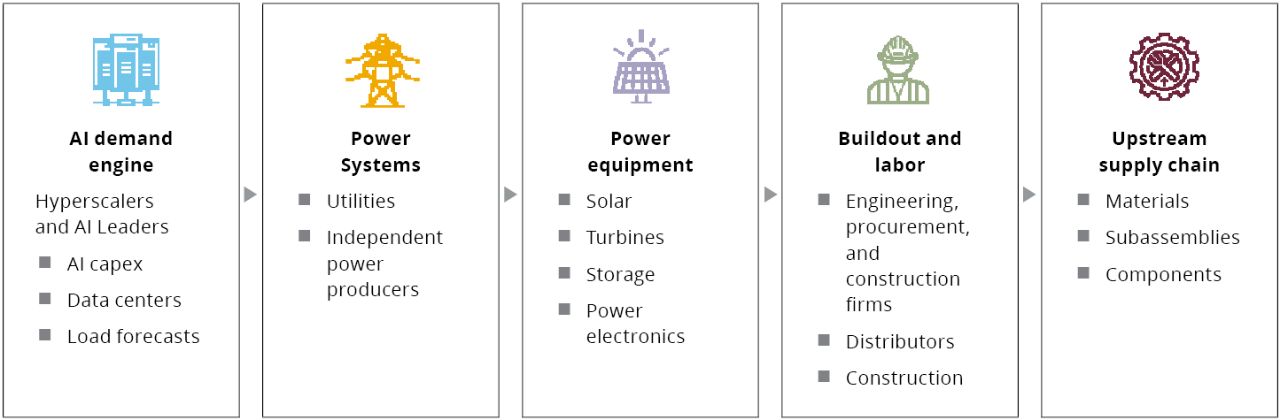
I believe AI could be the most significant development of the next quarter century. The AI revolution’s “second-order” economic beneficiaries may be found beyond the chipmakers, cloud platforms, and model developers leading the first wave. As AI investment drives demand for data centers and power, the effects are already rippling through utilities, grid equipment, construction, and other areas of the AI ecosystem (FIGURE 1). Over time, the opportunity should broaden further to companies that use AI to improve productivity, reduce costs, and strengthen their existing businesses.

Investment Lesson: Treat AI as a cross-asset, cross-sector theme rather than a narrowly defined technology equity allocation. For example, consider infrastructure opportunities and real-asset strategies that hold commodities, natural-resource equities, and infrastructure-related assets. 
 

AI could be the most significant development of the next quarter century.


FIGURE 1

AI Investments Ripple Across the Economy
Broadening Set of Beneficiaries

AI Investments Ripple Across the Economy

Source: Wellington Management. For illustrative purposes only.


2. Find Opportunities in AI's Growing Pains

China’s industrialization and economic growth were supported largely by coal and contributed to massive growth in emissions. But those rising emissions ultimately prompted industrial policy that supported green-energy innovation. Today, China is the global leader in the production of solar panels, electric vehicles, and other clean-energy technologies.

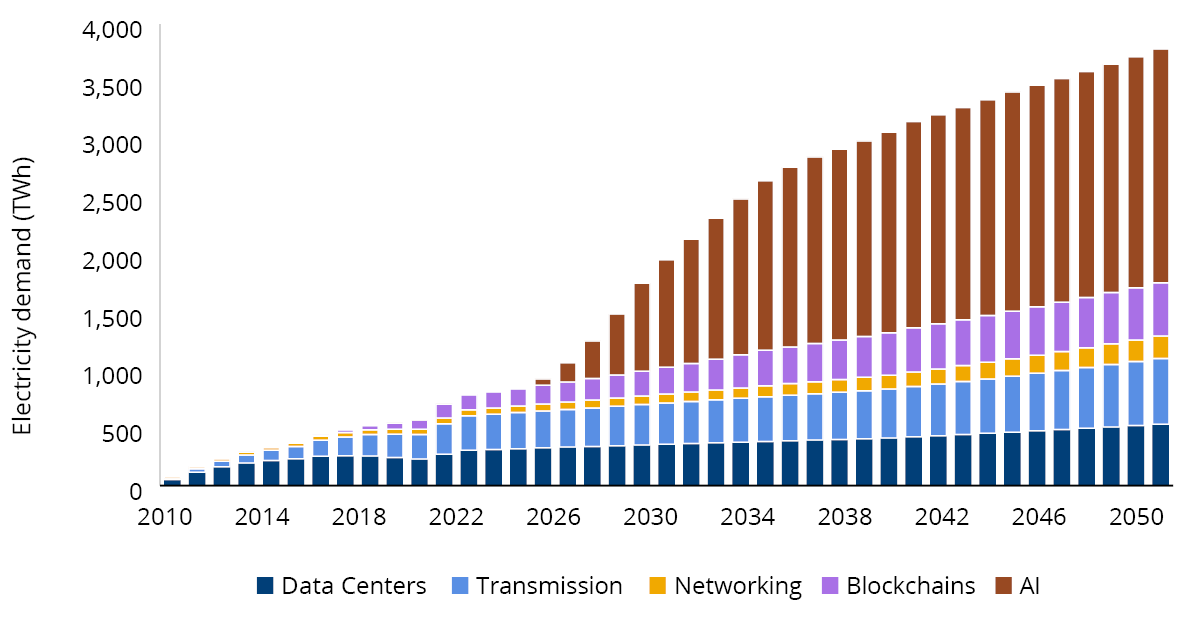
AI may create a similar paradox. A single ChatGPT query, for example, requires roughly 10 times as much electricity as a Google search, while an agentic AI system can require up to 1,000 times more power than a single chatbot interaction.1 I think there’s little question that AI will increase electricity consumption (FIGURE 2). But as the China experience suggests, necessity can spur innovation. AI leaders are investing heavily in renewable energy, storage, and related infrastructure—and are likely to continue doing so.


FIGURE 2

The AI Buildout Is Expected to Reshape Electricity Demand
Electricity Consumption from the Internet (%)

Electricity Consumption from the Internet (%)

Chart data: 2010–2050. Data from June 2024 onwards is forecasted. Actual results may vary, perhaps significantly. For illustrative purposes only. Source: Energy and AI: The Power and the Glory?, 4/8/24, Thunder Said Energy, 11/26.

China's emergence showed how economic bottlenecks can become investment opportunities.


China’s emergence also showed how economic bottlenecks can become investment opportunities. As industrialization accelerated, demand surged for essential inputs needed to build factories, power grids, cities, and transportation networks. 

AI may be creating a similar dynamic. The opportunity lies not simply in identifying where capital is being spent, but in determining which constraints could limit the buildout—and which companies are best positioned to relieve them.

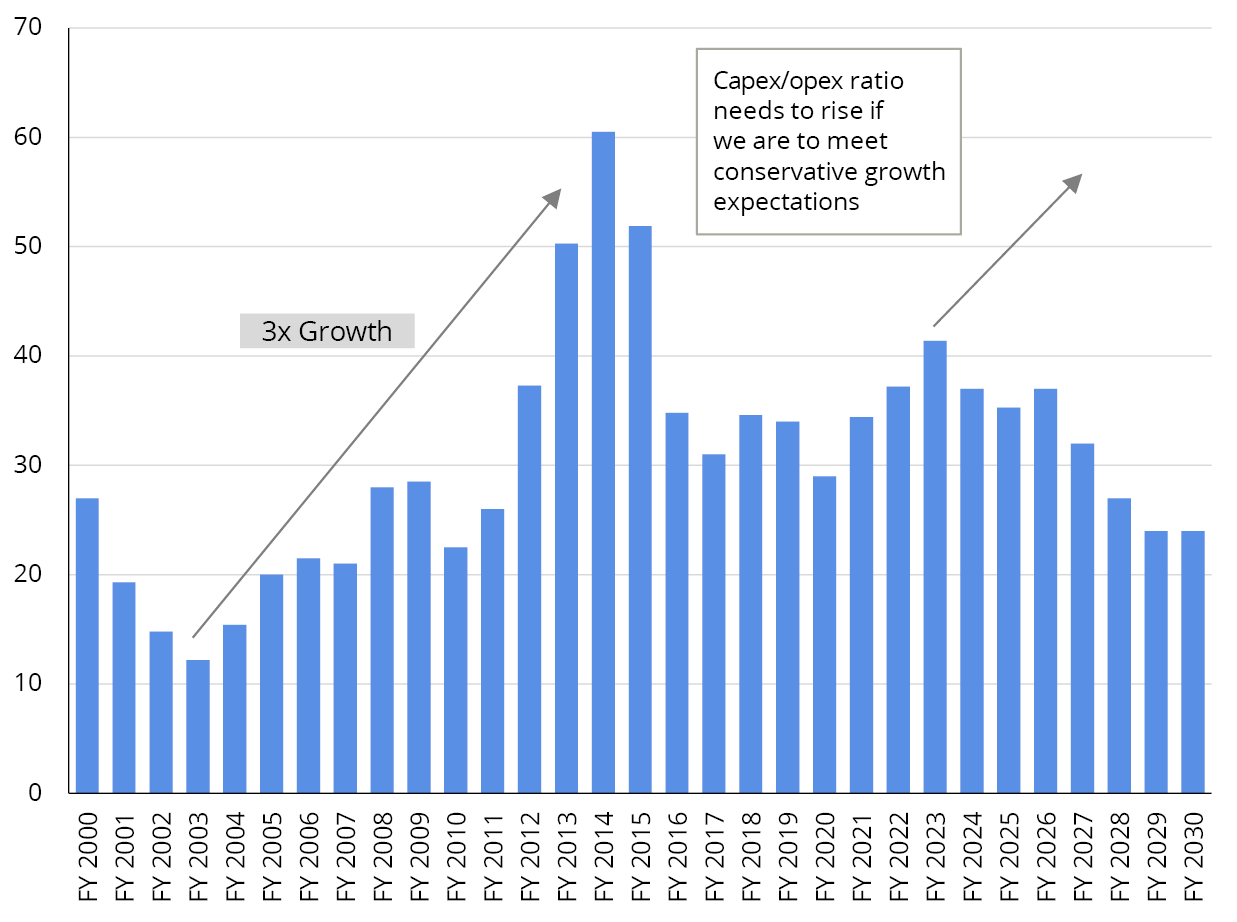
Copper illustrates the point. The AI buildout is driving demand for copper across data centers, power equipment, transmission networks, and supporting infrastructure. At the same time, copper-mine productivity is declining, and new supply is difficult to develop. To meet even conservative assumptions for growth in AI infrastructure, miners may need to increase capital expenditures relative to operating expenditures (FIGURE 3).

To incentivize that investment, copper prices will likely need to rise. Even then, the industry may struggle to increase supply because of limited exploration over the last 15 years, skills shortages, and permitting and environmental challenges. Both the copper commodity and copper miners could benefit.


FIGURE 3

Spending Will be Needed to Avoid Copper Constraint on AI Growth
Copper Capital Expenditures as a % of Operating Expenses (Capex/Opex*)

Copper Capital Expenditures as a % of Operating Expenses (Capex/Opex)

For illustrative purposes only. * Capex refers to capital expenditures for major, long-term physical or intangible assets. Opex refers to operating expenses, i.e., ongoing day-to-day costs required to run a business and keep it functioning. Sources: Bloomberg, Wellington Management, 11/26.


Water is another emerging constraint. Data centers need it for cooling, while semiconductor manufacturers rely on it throughout production—often in regions already facing water stress. These pressures could create investment opportunities in companies that enable water resilience, whether through liquid cooling, water treatment, recycling, reclamation, or other technologies.

Investment Lesson: Consider investing in the potential solutions to AI-related challenges. Public and private markets can each provide access to distinct stages of innovation. Public markets may provide access to scaled incumbents at later stages of adoption, with established revenue streams and greater liquidity. Private markets may provide earlier exposure to emerging categories.


Investment Lesson: Consider investing in the potential solutions to AI-related challenges.


3. Stay Nimble as AI Leadership Shifts

As China demonstrated by turning its emissions problems into green-energy innovation, an enduring megatrend can bring rotating winners and losers, along with periods of overinvestment. The companies and sectors that benefited from China’s rise varied over time as the cycle evolved.

With AI, we’ve already seen swings in market sentiment and business results for hyperscalers, model providers, software companies, and other parts of the ecosystem. These fluctuations underscore how quickly perceived winners and losers can shift as the technology advances and adoption spreads across the economy.

The AI investment cycle may also prove more durable than some expect. Countries increasingly view AI models, semiconductors, and computing capacity as strategic assets—critical not only to economic growth but also to long-term competitiveness and national security.

This strategic dimension matters for investors. Productivity gains may emerge unevenly, corporate returns may disappoint, and today’s bottlenecks may eventually become areas of overcapacity. But once a capability is considered strategically essential, the willingness to invest can persist well beyond a typical technology cycle.

Investment Lesson: Consider leaning into active management. The China experience reminds us that a powerful macro trend doesn’t diminish the importance of valuation, timing, or returns on capital. A compelling growth story can still produce both spectacular winners and disappointing investments. In such a dynamic environment, investing in a passive semiconductor or AI index fund may simply not be enough.


Talk to your financial professional to learn how AI technologies are transforming market opportunities.


1 Sources: Electricity 2024: Analysis and forecast to 2026, January 2024, IEA; How Do AI Agents Spend Your Money? Analyzing and Predicting Token Consumption in Agentic Coding Tasks, October 2026, Longju Bai, Zhemin Huang, Xingyao Wang, Jiao Sun, Rada Mihalcea, Erik Brynjolfsson, Alex Pentland, Jiaxin Pei.

Important Risks: Investing involves risk, including the possible loss of principal. • Focusing on one or more sectors, including the information technology, consumer discretionary and communication services sectors, may subject investors to increased volatility and risk of loss if adverse developments occur. • Investments in the commodities market may increase the Fund’s liquidity risk, volatility and risk of loss if adverse developments occur. Investments linked to prices of commodities may be considered speculative. • Foreign investments may be more volatile and less liquid than U.S. investments and are subject to the risk of currency fluctuations and adverse political, economic and regulatory developments. These risks may be greater, and include additional risks, for investments in emerging markets or in a particular geographic region or country, such as China.

This information should not be considered investment advice or a recommendation to buy/sell any security. In addition, it does not take into account the specific investment objectives, tax and financial condition of any specific person. This information has been prepared from sources believed reliable, but the accuracy and completeness of the information cannot be guaranteed.


WP930 6109300
Insight from Sub-Adviser Wellington Management
Author Headshot
Vice Chair and Senior Managing Director


The material on this site is for informational and educational purposes only. The material should not be considered tax or legal advice and is not to be relied on as a forecast. The material is also not a recommendation or advice regarding any particular security, strategy or product. Hartford Funds does not represent that any products or strategies discussed are appropriate for any particular investor so investors should seek their own professional advice before investing. Hartford Funds does not serve as a fiduciary. Content is current as of the publication date or date indicated, and may be superseded by subsequent market and economic conditions.

Investing involves risk, including the possible loss of principal. Investors should carefully consider a fund's investment objectives, risks, charges and expenses. This and other important information is contained in the mutual fund, or ETF summary prospectus and/or prospectus, which can be obtained from a financial professional and should be read carefully before investing.

Mutual funds are distributed by Hartford Funds Distributors, LLC (HFD), Member FINRA|SIPC. ETFs are distributed by ALPS Distributors, Inc. (ALPS). Advisory services may be provided by Hartford Funds Management Company, LLC (HFMC) or its wholly owned subsidiary, Lattice Strategies LLC (Lattice). Certain funds are sub-advised by Wellington Management Company LLP and/or Schroder Investment Management North America Inc (SIMNA). Schroder Investment Management North America Ltd. (SIMNA Ltd) serves as a secondary sub-adviser to certain funds. HFMC, Lattice, Wellington Management, SIMNA, and SIMNA Ltd. are all SEC registered investment advisers. The funds and other products referred to on this Site may be offered and sold only to persons in the United States and its territories.

Hartford Funds refers to HFD, Lattice, and HFMC, which are currently not affiliated with any sub-adviser or ALPS.

On June 3, 2026, The Hartford Insurance Group, Inc. (“The Hartford”) and Wellington announced that they had reached a definitive agreement under which Wellington Investment Advisors Holdings, LLP, Wellington’s corporate parent, will acquire Hartford Funds. Upon closing Hartford Funds will be integrated into Wellington’s U.S. Wealth business. The deal is expected to close in the first quarter of 2027, subject to regulatory and fund approvals. Upon closing, Hartford Funds would become an affiliate of Wellington. For more information, click here.

© Copyright 2026 Hartford Funds Management Group, Inc. All Rights Reserved. Not FDIC Insured | No Bank Guarantee | May Lose Value