



• Products
  • Insights
  • Practice Management
  • Resources
  • About Us

Investors seeking reliable income from their portfolios may face a dilemma: Choosing bonds typically means receiving some income, but yields were historically low for years until the recent rise in interest rates. Conversely, choosing dividend-paying equities typically means taking on the full risk of an unpredictable market. 

Derivative-income funds, which blend stock ownership with options1 contracts to generate additional cash flow, seek to address this imbalance. By selling options, they can often offer a higher level of income with a more risk-aware profile than an equity-only approach to income. This approach may appeal to investors seeking an income source without the risks typically associated with bonds or a fully invested equity solution, as well as to income-seeking investors who are tax-aware.

However, many strategies in this category prioritize the income generation aspect over long-term growth by pairing a passive equity index with an options overlay, or only consider tax implications as an afterthought by providing options exposure through equity-linked notes (ELN)2 that generate ordinary income and may reduce after-tax returns for investors.  

The Hartford Equity Premium Income ETF (HEMI) takes a different approach:

  • An actively managed equity portfolio – Rather than simply tracking a benchmark, HEMI’s actively managed equity sleeve offers the potential for excess return3 over the benchmark and enables active tax-loss harvesting.

  • A tax-first design – HEMI writes listed call options directly rather than using ELNs, which means the income generated is generally treated as capital gains rather than ordinary income from a tax standpoint. This enables tax-loss harvesting within the active equity sleeve, emphasizing the return of capital and in-kind efficiency. For a taxable investor, this combination is intended to preserve noticeably more yield on an after-tax basis than ELN-based peers, whose option income is taxed as ordinary income.4

  • More meaningful participation in markets – We intentionally target a higher beta5 with the intention of helping investors participate more fully in the market while still delivering a high level of income. This contrasts with the processes of some income-focused peers who invest in higher dividend stocks, which typically have a lower beta.


HEMI writes listed call options directly, which means the income generated is treated more favorably from a tax standpoint.


The Investment Process 

HEMI is built on three integrated components via close collaboration across our equity, derivatives, and tax teams.

1. Active US Equity Portfolio

The foundation of the strategy is a portfolio of typically 60-90 large-cap US equities, selected through rigorous bottom-up fundamental research. The team seeks companies with improving quality, positive business momentum, and attractive relative valuations. 

HEMI maintains a sector- and factor-neutral profile relative to the S&P 500 Index so that stock selection is the primary driver of results, as well as a disciplined, lower-turnover approach where position sizes are based on conviction and the range of potential outcomes.

2. Systematic Options Overlay

The primary source of HEMI’s additional income is premiums collected from systematically writing (selling) call options linked to the S&P 500 Index.

We believe our options overlay is differentiated from peers for several reasons, beginning with our use of short-dated options. The team writes call options with one-week expirations, which we believe can both generate more consistent premium income and retain meaningful upside participation across a range of market environments compared to longer-dated approaches.

We also employ a staggered or “laddered” structure rather than concentrating on a single expiration date. Every trading day, roughly 20% of the overlay expires and is rewritten. This diversifies timing and strike risk,6 creating more opportunities to reset positions as markets rise and further supporting a more consistent income and upside-capture profile.


Our tax-aware approach is treated as a core pillar of the process rather than an afterthought.


3. Integrated Tax-Aware Approach
Our tax-aware approach is treated as a core pillar of the process rather than an afterthought—another area in which we believe HEMI is particularly differentiated vs. its peers. For example, every position change in the equity sleeve is reviewed within a systematic tax-aware framework that balances commercial and tax considerations. This helps ensure trades are implemented in a tax-aware manner and coordinated with the options overlay. 

Because the Fund writes exchange-traded options on the S&P 500 Index (either directly or through an ETF) rather than using ELN, net gains on the options are treated as capital gains rather than being taxed as ordinary income. The actively managed equity sleeve then allows the team to realize capital losses that can offset the gains generated by the options overlay when it makes sense from a market perspective. This is an advantage that passive, index-tracking peers don’t have. 

Finally, HEMI also seeks to maximize the portion of distributions classified as return of capital with the goal of minimizing taxable distributions from the Fund. Return of capital is generally treated as tax-deferred income and reduces an investor’s current tax liability.


Income Sources

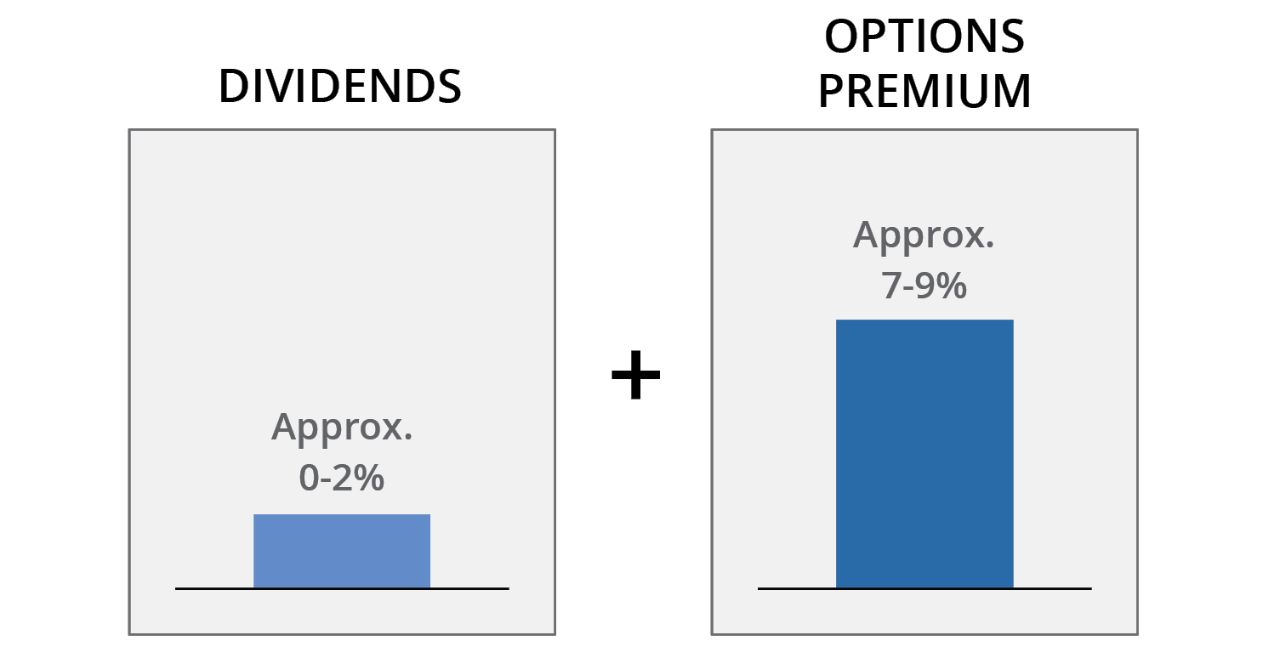
The Fund’s income is generated from two complementary sources: premium from the call-writing overlay and dividends from the underlying equity portfolio (FIGURE 1). The overlay does the majority of the work, with dividends providing a smaller, but steady, base. 

FIGURE 1

Income Generators

For illustrative purposes only. The ranges shown represent approximate percentages of the Fund’s income expected to come from stock dividends and options premiums. The split between the two sources is approximate and will vary with the level of market volatility, which drives option premium, and with the dividend yield of the underlying holdings.


HEMI’s Role in a Portfolio

HEMI can complement both traditional equity and fixed-income allocations by broadening an investor’s sources of income:

  • As a complement to core equity, it may help convert a portion of an equity allocation into a steadier income stream while retaining meaningful upside participation.
  • As a complement to fixed income, it can add an income source that doesn’t rely on duration7 or credit, which may be valuable when investors are concerned about interest-rate or credit risk.
  • As a dedicated income sleeve, it may serve investors who prioritize consistent monthly cash flow alongside long-term growth potential.


The Bottom Line

The Hartford Equity Premium Income ETF combines an actively managed US equity portfolio, a strategically designed, laddered call-options-writing overlay, and a tax-aware approach within a single, transparent ETF. Together, these components are designed to pursue a high and consistent level of monthly income, continued participation in equity markets, and improved after-tax outcomes. For risk-aware investors seeking to enhance income, we believe HEMI is a differentiated and thoughtfully constructed choice, distinguished by a tax-aware design built to keep more of the yield in investors’ hands.


To learn more about HEMI’s unique approach to equity income, talk to your financial professional.


S&P 500 Index is a market capitalization-weighted price index composed of 500 widely held common stocks.

1 Options are a type of derivative that gives an investor the right, but not the obligation, to buy or sell an underlying asset at a specific price on or before a certain date. A call option gives the investor the right to purchase an asset at a specified price (strike price) on or before a certain date (expiration date). 

2 Equity-linked notes (ELN) are a debt instrument that combines fixed-income features with potential equity returns to limit downside risk while potentially offering above-average return compared to regular bonds.

3 Excess returns are returns from a security or portfolio that exceed a benchmark or index with a similar level of risk.

4 Because HEMI writes options linked to the S&P 500 Index, they qualify as Section 1256 contracts. Section 1256 tax treatment provides a unique tax advantage for specific financial contracts by splitting all gains and losses into 60% long-term and 40% short-term capital gains rates, regardless of how long you hold the asset. This results in a significantly lower overall tax rate. 

5 Beta is a measure of risk that indicates the price sensitivity of a security or a portfolio relative to a specified market index.

6 Strike risk refers to the risk that the underlying asset’s price will not rise above the option’s strike price before expiration.

7 Duration is a measure of the sensitivity of an investment’s price to nominal interest-rate movement.

Important Risks: The Fund is new and has a limited operating history. Investing involves risk, including the possible loss of principal. Security prices of the Fund’s underlying holdings will fluctuate in value depending on general market and economic conditions and the prospects of individual companies. The market price of the Fund’s shares will fluctuate in response to changes in the Fund’s net asset value, intraday value of the Fund’s holdings, and the supply and demand for shares on the exchange. • The Fund is actively managed and does not seek to replicate the performance of a specified index. • The Fund sells (writes) options contracts on an underlying ETF and/or underlying index and is subject to the risks associated with writing (selling) call options, which include the risk that the Fund may be required to sell an underlying security at a disadvantageous price or below the market price of such underlying security, at the time the option is exercised. During the life of a written call option, the Fund forgoes the opportunity to participate in increases in the market value of the underlying security or instrument covering the option above the sum of the premium and the exercise price, potentially causing underperformance in rising markets, but retains the risk of loss should the price of the underlying security or instrument decline. The use of call options could increase the volatility of the Fund’s returns and may increase the risk of loss to the Fund. These types of transactions generally result in certain tax consequences to the Fund, including a return of capital to shareholders. • The Fund may trade FLEX options, which are subject to additional risks including the risk that the value of the FLEX options may not correlate to the NAV of the option’s underlying ETF and/or an underlying index and such options may expire with little or no value. In addition, the Fund may suffer significant losses if the Options Clearing Corporation on which the FLEX options trades are settled is unable or unwilling to perform its obligations. • Derivatives are generally more volatile and sensitive to changes in market or economic conditions than other securities; their risks include currency, leverage, liquidity, index, pricing, valuation, and counterparty risk. • The securities of large market capitalization companies may underperform other segments of the market. • Because the Fund is non-diversified, it may invest in a smaller number of issuers, and may be more exposed to risks and volatility than a more broadly diversified fund. • The Fund may effect creations and redemptions partly or wholly for cash, rather than in-kind, which may make the Fund less tax-efficient and incur more fees than an ETF that primarily or wholly effects creations and redemptions in-kind. 

The views expressed herein are those of Wellington Management, are for informational purposes only, and are subject to change based on prevailing market, economic, and other conditions. The views expressed may not reflect the opinions of Hartford Funds or any other sub-adviser to our funds. They should not be construed as research or investment advice nor should they be considered an offer or solicitation to buy or sell any security. This information is current at the time of writing and may not be reproduced or distributed in whole or in part, for any purpose, without the express written consent of Wellington Management or Hartford Funds.


WP916 5824889 HFA003728
From sub-advisor Wellington Management
Author Headshot
Senior Managing Director and Director of Global Derivatives
Author Headshot
Senior Managing Director and Equity Portfolio Manager

The material on this site is for informational and educational purposes only. The material should not be considered tax or legal advice and is not to be relied on as a forecast. The material is also not a recommendation or advice regarding any particular security, strategy or product. Hartford Funds does not represent that any products or strategies discussed are appropriate for any particular investor so investors should seek their own professional advice before investing. Hartford Funds does not serve as a fiduciary. Content is current as of the publication date or date indicated, and may be superseded by subsequent market and economic conditions.

Investing involves risk, including the possible loss of principal. Investors should carefully consider a fund's investment objectives, risks, charges and expenses. This and other important information is contained in the mutual fund, or ETF summary prospectus and/or prospectus, which can be obtained from a financial professional and should be read carefully before investing.

Mutual funds are distributed by Hartford Funds Distributors, LLC (HFD), Member FINRA|SIPC. ETFs are distributed by ALPS Distributors, Inc. (ALPS). Advisory services may be provided by Hartford Funds Management Company, LLC (HFMC) or its wholly owned subsidiary, Lattice Strategies LLC (Lattice). Certain funds are sub-advised by Wellington Management Company LLP and/or Schroder Investment Management North America Inc (SIMNA). Schroder Investment Management North America Ltd. (SIMNA Ltd) serves as a secondary sub-adviser to certain funds. HFMC, Lattice, Wellington Management, SIMNA, and SIMNA Ltd. are all SEC registered investment advisers. The funds and other products referred to on this Site may be offered and sold only to persons in the United States and its territories.

Hartford Funds refers to HFD, Lattice, and HFMC, which are currently not affiliated with any sub-adviser or ALPS.

On June 3, 2026, The Hartford Insurance Group, Inc. (“The Hartford”) and Wellington announced that they had reached a definitive agreement under which Wellington Investment Advisors Holdings, LLP, Wellington’s corporate parent, will acquire Hartford Funds. Upon closing Hartford Funds will be integrated into Wellington’s U.S. Wealth business. The deal is expected to close in the first quarter of 2027, subject to regulatory and fund approvals. Upon closing, Hartford Funds would become an affiliate of Wellington. For more information, click here.

© Copyright 2026 Hartford Funds Management Group, Inc. All Rights Reserved. Not FDIC Insured | No Bank Guarantee | May Lose Value