



• Products
  • Insights
  • Practice Management
  • Resources
  • About Us

When you hear “health-savings account” or HSA, you may think of a separate account you use to pay for prescriptions and office visits without impacting your main spending account. But an HSA can do much more than just pay bills. 

HSAs are unique because the funds in them carry over from year to year, remain yours if you change jobs, and can often be invested to provide potential long-term growth. Combine that with their tax benefits, and you have a powerful savings tool for healthcare expenses today and in the future.  


One Account, Three Tax Advantages

One of the most powerful traits of an HSA is their tax-advantaged treatment: 

  1. Contributions Are Pre-Tax – Contributions made through payroll deductions can generally be made with pre-tax dollars, helping to reduce your overall federal tax liability. Contributions made with after-tax dollars may be tax deductible. 

  2. Your Money Grows Tax-Free – If your provider allows it, you can invest your HSA’s balance once you hit a certain asset threshold. Earnings accumulate free from federal income tax in the account.

  3. Qualified Withdrawals Are Tax-Free – When you use your HSA funds to pay for qualified medical expenses, withdrawals are typically free from federal income tax.
     

There’s No “Use it or Lose it”

Unused HSA assets carry over from year to year, unlike flexible spending accounts (FSAs), which typically require you to use your funds within a certain timeframe or forfeit them. This presents two advantages for your HSA: You don’t have to accurately predict your healthcare costs in any given year, and unused funds can continue accumulating for future expenses. This is especially useful because the account is yours even if you change employers or health plans. 


Investing your HSA could provide significant potential growth for healthcare expenses in retirement.


If you don’t need all your HSA contributions for current expenses, investing them could provide meaningful potential growth to help cover healthcare expenses in retirement (FIGURE 1). Many HSA providers allow you to invest once you reach a certain threshold while keeping a minimum balance available for current expenses.
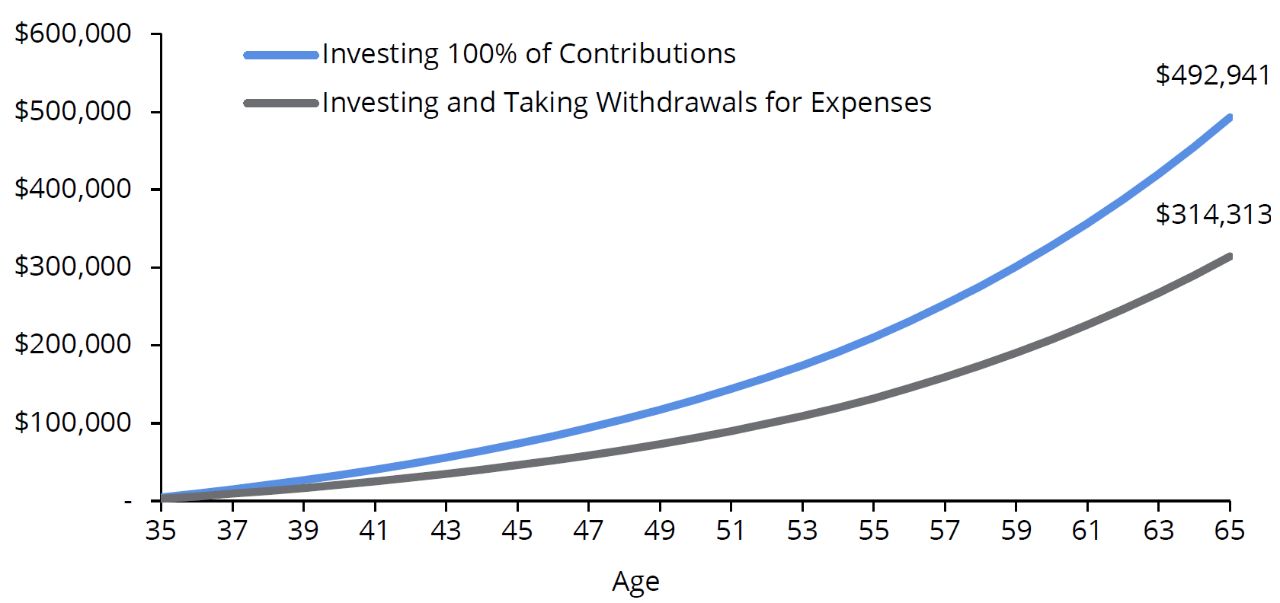
FIGURE 1

An HSA Could Give You a Healthcare Nest Egg for Retirement

Max Out Your HSA Contributions Before Retirement

Hypothetical account growth for a 35-year-old investor who begins contributing $4,500 in their HSA annually until age 55, when the contribution increases to $5,500 to reflect the additional $1,000 catch-up available to individuals age 55 and older. The scenario with withdrawals assumes annual withdrawals of $1,750 for healthcare expenses. Both options assume monthly contributions and a hypothetical 7% investment return that is not guaranteed. Does not reflect the performance of any particular investment or investment-related fees and expenses. Actual results will vary. Source: Hartford Funds. 

Know the Rules

Only certain healthcare plans make you eligible to open or contribute to an HSA. You’re generally eligible if you have healthcare coverage under a qualifying high-deductible plan (minimum of $1,750 for 2027), aren’t enrolled in Medicare, and can’t be claimed as a dependent on someone else’s tax return. 

Federal rules govern annual contribution limits. For 2027, the limits are:

  • $4,500 for individuals with self-only coverage
  • $9,000 for individuals with family coverage
  • An additional $1,000 catch-up contribution for eligible individuals age 55 and older.


What Expenses Can I Use my HSA For?

HSA assets can be withdrawn tax-free for a wide range of qualified medical expenses. These can include deductibles and copays, prescription drugs, dental treatments, eye exams, eyeglasses and contact lenses, hearing aids, and even some long-term-care expenses. The IRS provides a detailed list of qualified expenses on its website. Withdrawals for nonqualified expenses may be subject to regular income taxes and an additional 20% penalty. 


Spend Today, Save for Retirement 

An HSA is a great way to help you handle today’s healthcare expenses. But focusing only on today’s bills could mean overlooking some of the account’s longer-term potential.

The combination of triple-tax advantages, year-to-year portability, and the potential to invest assets for long-term growth means an HSA can also play a role in preparing for future healthcare expenses.


Talk to your financial professional to learn more about how to make the most of an HSA. 


This information should not be considered investment advice or a recommendation to buy/sell any security. In addition, it does not take into account the specific investment objectives, tax and financial condition of any specific person. The information is not intended to be either tax or legal advice. This information has been prepared from sources believed reliable but the accuracy and completeness of the information cannot be guaranteed. This material and/or its contents are current at the time of writing and are subject to change without notice. This material is provided for educational purposes only. 

Investing involves risk, including the possible loss of principal.


CCWP019 6033712

The material on this site is for informational and educational purposes only. The material should not be considered tax or legal advice and is not to be relied on as a forecast. The material is also not a recommendation or advice regarding any particular security, strategy or product. Hartford Funds does not represent that any products or strategies discussed are appropriate for any particular investor so investors should seek their own professional advice before investing. Hartford Funds does not serve as a fiduciary. Content is current as of the publication date or date indicated, and may be superseded by subsequent market and economic conditions.

Investing involves risk, including the possible loss of principal. Investors should carefully consider a fund's investment objectives, risks, charges and expenses. This and other important information is contained in the mutual fund, or ETF summary prospectus and/or prospectus, which can be obtained from a financial professional and should be read carefully before investing.

Mutual funds are distributed by Hartford Funds Distributors, LLC (HFD), Member FINRA|SIPC. ETFs are distributed by ALPS Distributors, Inc. (ALPS). Advisory services may be provided by Hartford Funds Management Company, LLC (HFMC) or its wholly owned subsidiary, Lattice Strategies LLC (Lattice). Certain funds are sub-advised by Wellington Management Company LLP or Schroder Investment Management North America LLC (SIMNA). Schroder Investment Management North America Ltd. (SIMNA Ltd) serves as a secondary sub-adviser to certain funds. HFMC, Lattice, Wellington Management, SIMNA, and SIMNA Ltd. are all SEC registered investment advisers. The funds and other products referred to on this Site may be offered and sold only to persons in the United States and its territories.

Hartford Funds refers to HFD, Lattice, and HFMC, which are currently not affiliated with any sub-adviser or ALPS.

On June 3, 2026, The Hartford Insurance Group, Inc. (“The Hartford”) and Wellington announced that they had reached a definitive agreement under which Wellington’s corporate parent will acquire Hartford Funds. Upon closing Hartford Funds will be integrated into Wellington’s U.S. Wealth business. The deal is expected to close in the first quarter of 2027, subject to regulatory and fund approvals. Upon closing, Hartford Funds would become an affiliate of Wellington. For more information, click here.

© Copyright 2026 Hartford Funds Management Group, Inc. All Rights Reserved. Not FDIC Insured | No Bank Guarantee | May Lose Value