Competing Paths Complicate Defense Spending Plans
With the $70 billion reconciliation package focused on immigration now behind them, Republicans are beginning to outline a follow-up measure. The next proposal is expected to focus on defense spending, though identifying sufficient offsets remains a key challenge.
Some potential ways to pay for the package have already been floated. Centers for Medicare and Medicaid Services Administrator Mehmet Oz has discussed generating savings by targeting fraud in Medicaid and hospice programs, as well as tightening eligibility around Affordable Care Act enrollment. Still, proposals tied to healthcare are likely to face resistance from more moderate Republicans, particularly in the lead-up to midterm elections.
Other funding ideas are also emerging. House Natural Resources Committee Chairman Bruce Westerman has proposed expanding oil and gas leasing on federal lands, pointing to energy revenues as a potential source of offsets. While Republican leaders initially aimed to advance legislation before the August recess, the timeline appears fluid as they work through competing priorities within the conference.
At the same time, divisions are becoming more apparent in how to fund a broader defense buildup. The House is moving forward with its fiscal year 2027 National Defense Authorization Act at approximately $1.15 trillion, maintaining the traditional authorization process. The Trump administration, however, is also seeking an additional $350 billion to support munitions, shipbuilding, missile defense, and related priorities.
That approach is encountering resistance in the Senate, where appropriators have raised concerns about relying on a party-line measure that may not ultimately pass. Those concerns are heightened by near-term demands, including costs associated with the conflict in Iran, which are adding to longer-term modernization wish list.
In practice, this leaves multiple tracks in motion. Authorizing committees are continuing their work, while the Trump administration pursues additional funding through reconciliation. Senate appropriators, however, may prove to be a key constraint. If those concerns persist, Congress could again fall back on more familiar paths, with near-term defense needs taking priority and other spending deferred to the annual appropriations process or future negotiations.
Crypto Legislation Gains Ground, but Faces Hurdles
The CLARITY Act, which seeks to clarify oversight of cryptocurrencies between the SEC and Commodity Futures Trading Commission (CFTC), is gaining traction but remains short of the finish line. After passing the House with bipartisan support last summer, the bill advanced out of the Senate Banking Committee in May and is now positioned for floor consideration—marking meaningful progress in an area where legislative efforts have often stalled.
Still, the transition from committee to the full Senate introduces new challenges. Supporters will need to maintain a broad coalition through debates over ethics provisions, anti-money laundering requirements, stablecoin treatment, and the ongoing jurisdictional divide between the SEC and CFTC. At the same time, opposition from the banking industry remains a key hurdle, particularly around provisions that could make stablecoins more competitive with traditional deposits.
The pace of legislation has allowed regulators to take a more active role. As Congress deliberates, agencies such as the SEC, CFTC, and Treasury continue to shape the regulatory framework through existing authorities and rulemaking. The result is a policy landscape that is evolving on multiple fronts, with legislative action still uncertain.
Housing Efforts Face Structural Constraints
Congress is also advancing a bipartisan effort aimed at limiting institutional ownership in the single-family housing market, an issue that has gained attention in an election-year environment. While the proposal has a clearer path politically, its practical impact on affordability may be more limited.
Institutional investors account for a relatively small share of the overall housing stock, and in many cases focus on distressed properties that would not otherwise attract individual buyers. Restricting future purchases could modestly increase inventory at the margin, but may also tighten rental supply, leaving the net effect on affordability less pronounced.
That dynamic suggests a gap between the policy’s political appeal and its potential economic impact. While the measure may resonate with voters amid ongoing housing challenges, broader supply constraints and rising ownership costs are likely to remain the primary drivers of affordability trends.
The Midterm Map Comes into Focus
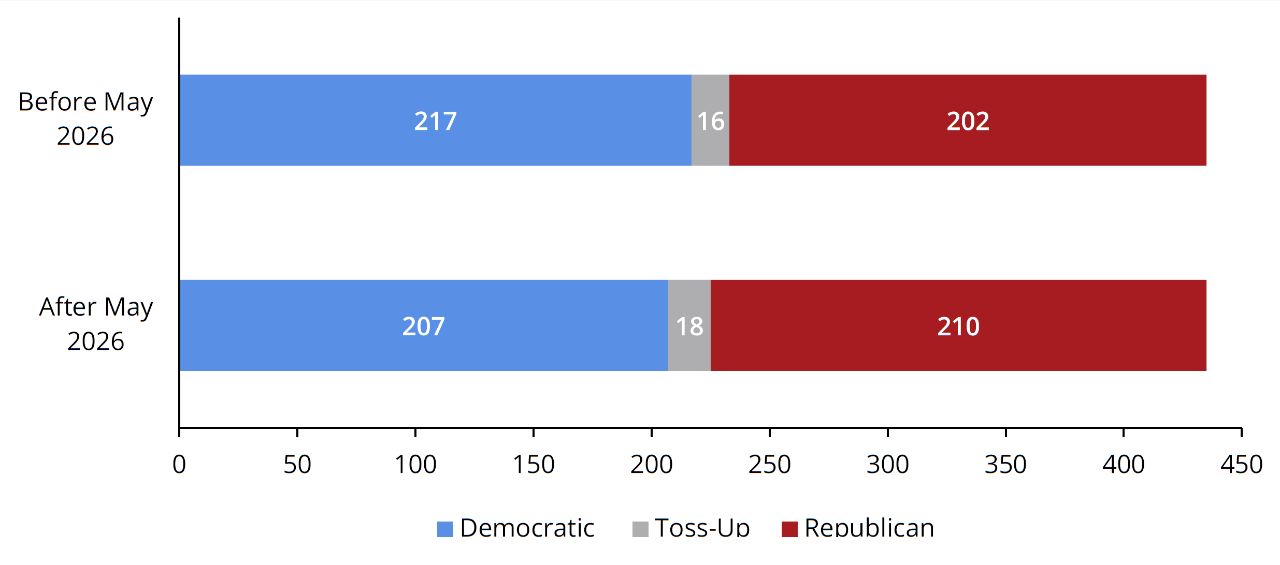
With most redistricting decisions now in place, the contours of the 2026 midterm elections are coming into clearer focus. The House remains competitive in a typical midterm sense, particularly given Republicans’ narrow majority, but the map itself has shifted. Mid-decade redistricting across several states has modestly improved Republicans’ positioning, particularly across the South, meaning Democrats may need a stronger national backdrop to regain ground.
The result is a more complex electoral dynamic. Beyond serving as a referendum on policy and economic conditions, the outcome will also reflect how candidates perform within a reshaped map that is no longer evenly balanced. In the Senate, the landscape remains more candidate-driven, with factors such as retirements and state-level dynamics likely to play a larger role than redistricting.